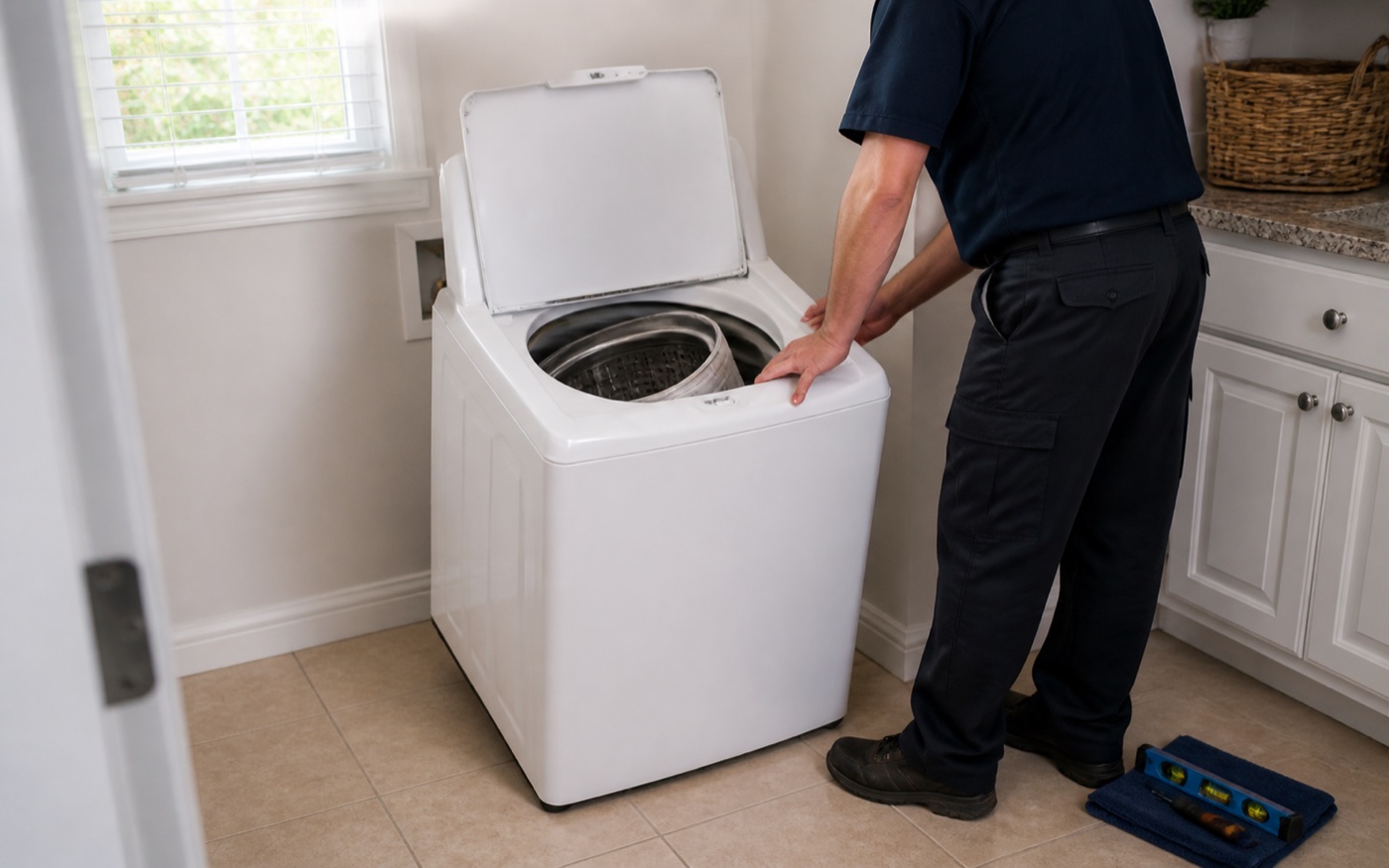
Start With One Simple Question: Does It Shake With Every Load?
This immediately divides the problem into two very different categories.
It shakes only with certain loads
Common examples include:
- one blanket;
- bath mats;
- several heavy towels;
- one pair of jeans;
- pillows;
- a small but heavy load.
That often means the washer is struggling to balance the load rather than suffering a major mechanical failure.
It shakes with almost everything
If normal mixed loads repeatedly produce violent movement, investigate leveling, flooring, suspension, tub support, bearings, and basket condition.
It shakes even when empty
This is one of the most useful diagnostic clues. An empty washer should not become violently unbalanced. If it does, the problem is much less likely to be laundry distribution and much more likely to be mechanical or installation-related.
What Actually Happens Before High-Speed Spin?
Modern washers normally do not jump directly from washing to maximum RPM. Before high-speed spin, the machine may:
- drain the water;
- rotate the basket slowly;
- sense load distribution;
- redistribute clothing;
- attempt a faster spin;
- slow down if imbalance is detected;
- try again.
That is why you may see the timer appear to pause or even increase. The washer is sometimes trying to protect itself.
A machine that repeatedly goes from slow spin to shake, then stop, redistribute, and shake again may have a load-balance problem or a suspension system that can no longer control the tub properly.
First Rule: Do Not Diagnose Suspension From One Bad Load
One bulky item can make a perfectly good washer look broken. A wet comforter or bath mat can become extremely heavy and stay concentrated on one side of the basket.
Before replacing parts, test the washer with a more representative load, such as several shirts, a few towels, or similar-weight clothing distributed around the basket.
If the washer becomes stable with a balanced load, the machine may be operating normally. If it still hits the cabinet, keep diagnosing.
The Washer May Simply Be Out of Level
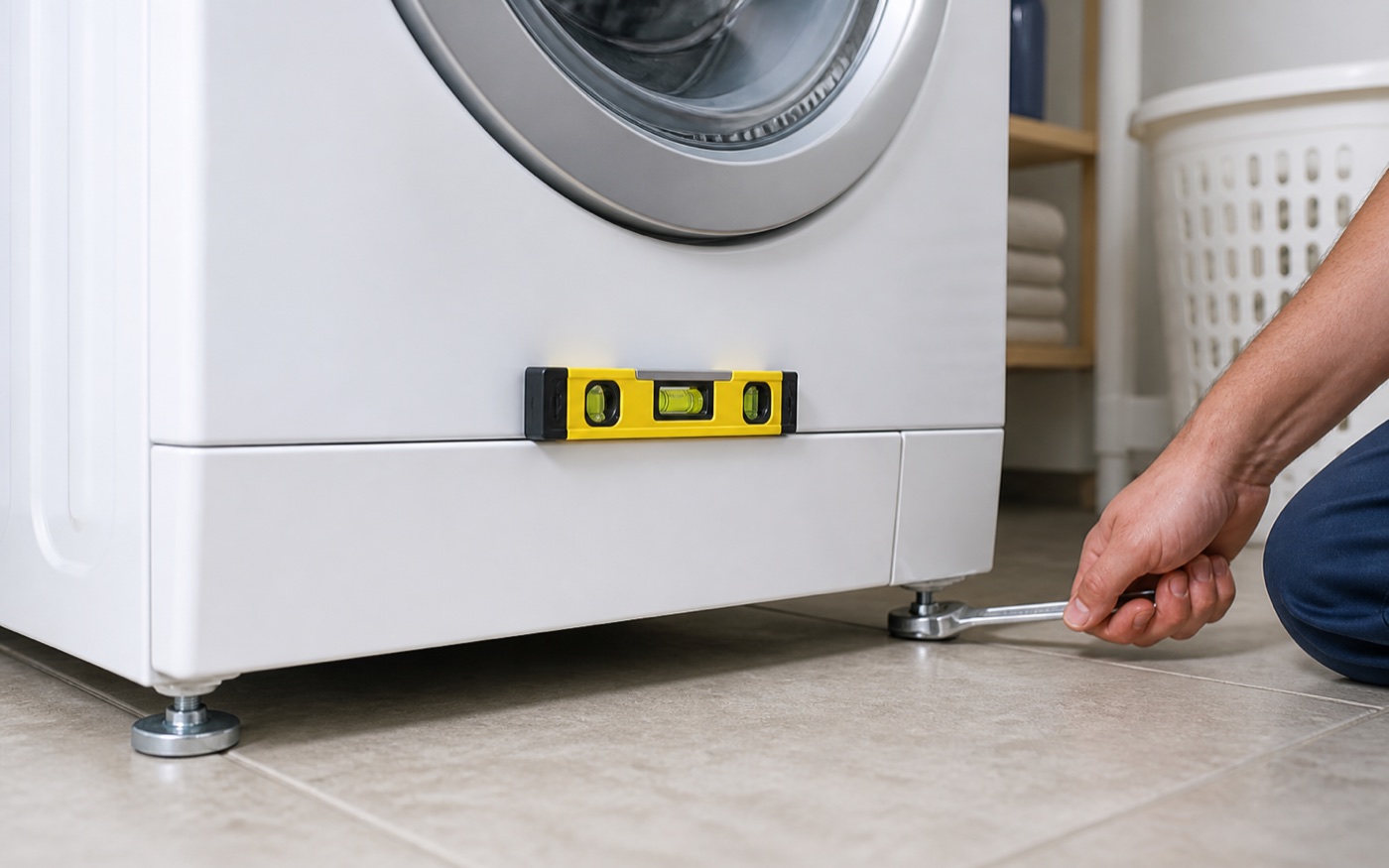
This sounds basic, but it matters. The washer needs stable contact with the floor. If one foot is slightly off the floor, the cabinet can rock as the basket accelerates.
You may notice:
- vibration becomes worse as RPM increases;
- washer moves diagonally;
- one corner lifts slightly;
- pushing on the cabinet makes it rock.
Check the machine front-to-back and side-to-side. More importantly, press on opposite top corners. The cabinet should feel solid.
A washer can appear visually level and still have one foot carrying less weight than the others.
The Floor Matters Too
Sometimes the washer is not the real source of the movement. A flexible floor can amplify normal vibration.
This is more common on second floors, wood-frame flooring, older homes, raised floors, and poorly supported laundry rooms.
A washer may operate normally on concrete but shake dramatically on a flexible wooden floor. If the entire floor moves with the washer, correcting the appliance alone may not eliminate the vibration.
Recently Installed Front-Load Washer? Check Shipping Bolts
If a new or recently moved front-load washer shakes violently from its first spin cycle, shipping hardware should be considered immediately.
Front-load washers commonly use shipping bolts or transport hardware to prevent the suspended tub from moving during transportation. If that hardware remains installed, the washer may shake violently, jump, make severe banging noises, and transfer vibration directly into the cabinet.
Top-Load Washer: Suspension Rods Are a Major Suspect
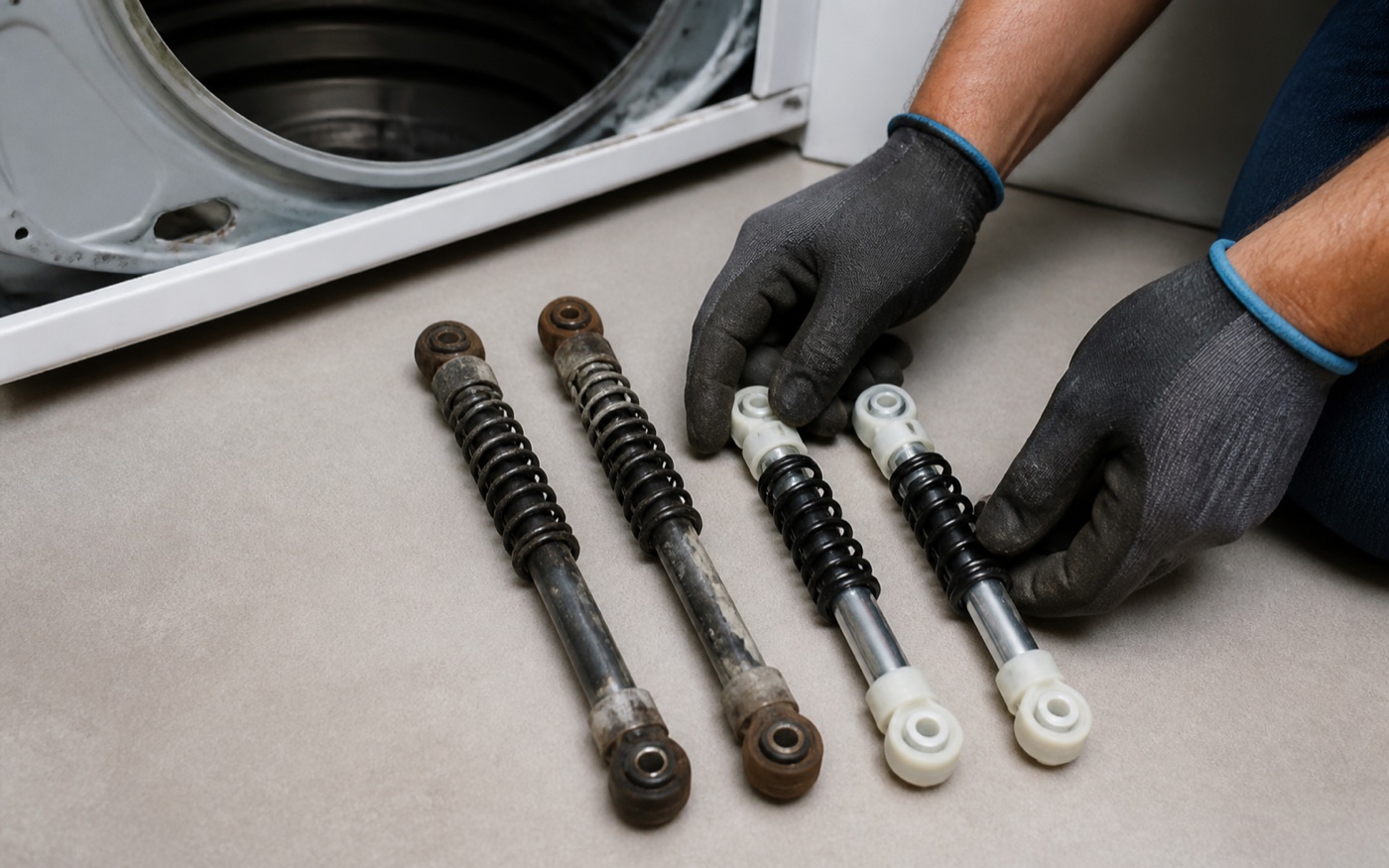
Many modern top-load washers suspend the tub using rods with springs and damping components. Their job is not simply to hold the tub. They must control the tub as several pounds of wet laundry accelerate to high speed.
As suspension components wear, the washer may:
- bounce excessively;
- hit the cabinet;
- walk;
- repeatedly stop the spin cycle;
- show an unbalanced-load error;
- complete spin only with small loads.
A useful field clue
With the washer off, gently press the basket or tub downward and release it. A healthy suspension system should control the movement.
If the tub rebounds several times, feels unusually soft, drops too easily, or sits noticeably off-center, the suspension deserves closer inspection. This is only a screening check, not a complete diagnosis.
Why Calibration Sometimes Helps and Sometimes Does Nothing
Many electronic washers have a calibration procedure. Calibration allows the control to relearn parameters related to basket movement, load sensing, motor behavior, and balance detection.
Calibration can be useful after suspension replacement, control replacement, moving the washer, or certain service procedures.
But calibration cannot repair worn suspension rods, a damaged bearing, a loose basket, or a broken tub support. If a washer is mechanically unstable, repeatedly recalibrating it may temporarily change behavior without fixing the cause.
Front-Load Washer: Shock Absorbers Control Tub Movement
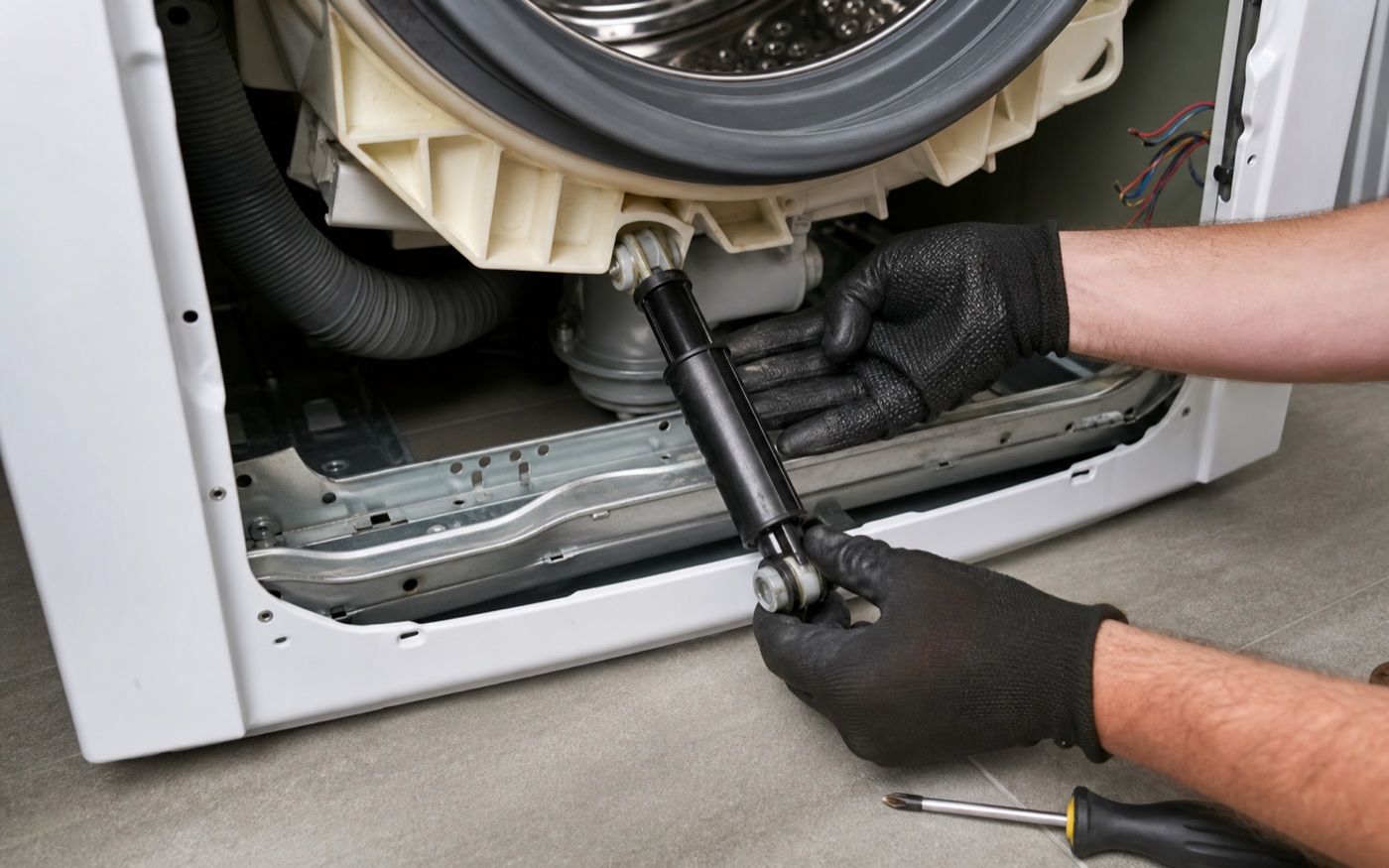
Front-load washers commonly use shocks or dampers between the outer tub and cabinet. When they wear, the suspended tub can move too freely.
Common symptoms include:
- severe movement during spin;
- banging against the cabinet;
- vibration worse with medium or heavy loads;
- tub oscillating several times after being pushed;
- machine stable at low speed but violent during acceleration.
A shock absorber can sometimes fail mechanically without looking dramatically broken. That is why the entire suspension system should be evaluated, not just visually inspected from a distance.
Springs and Counterweights Matter Too
Front-load tubs may also use support springs and heavy counterweights. The counterweights help stabilize the tub during high-speed rotation.
Problems can occur when a mounting bolt loosens, a counterweight cracks, a spring breaks, a spring comes out of position, or a mounting point in the tub or cabinet is damaged.
A loose counterweight can produce a very heavy knocking sound that may be mistaken for a bearing failure.
Listen to the Sound, Not Just the Vibration
Different failures often sound different.
Repetitive cabinet banging
Think about severe imbalance, weak suspension, a loose counterweight, or the tub contacting the cabinet.
Deep roaring that increases with spin speed
Think about a tub bearing, rear bearing, or bearing seal failure.
Scraping once per revolution
Think about the basket contacting the tub, a foreign object, a bent component, damaged bearing, or basket problem.
Metallic knocking
Think about a loose component, counterweight, pulley, basket support, or suspension hardware.
Machine simply walks without loud internal noise
Think first about feet, floor, leveling, and load distribution.
Check the Basket by Hand
With the washer off, slowly rotate the basket by hand. It should move smoothly.
Pay attention to grinding, rough spots, scraping, clicking, and excessive side-to-side movement.
Now gently lift or move the basket. A small amount of movement may be normal depending on the design. A basket that feels loose relative to the tub can indicate a more serious support or bearing problem.
When the Bearing Becomes the Main Suspect
A worn bearing usually creates more than simple shaking. Look for a combination of symptoms:
- loud roaring during spin;
- noise becomes worse as RPM increases;
- basket feels rough when rotated;
- excessive basket play;
- possible water leakage near the bearing area;
- rusty residue in severe cases.
A bearing failure can cause imbalance because the basket is no longer rotating concentrically. At that point, replacing suspension alone will not solve the problem.
A Loose or Damaged Basket Can Mimic Bad Suspension
Sometimes the suspension is doing its job, but the rotating basket itself is no longer stable.
Possible areas include the basket hub, drive block, basket support, shaft connection, or spider assembly on some front-load machines.
If the basket moves independently of the tub or visibly wobbles during slow rotation, investigate the basket mounting system before blaming the suspension.
Front-Load Washer Spider Failure
On some front-load designs, the inner stainless basket is connected to the drive shaft through a multi-arm support often called a spider.
If that support cracks or corrodes, the basket can become off-center. Possible clues include basket wobble, scraping during rotation, severe shaking with reasonable loads, excessive play at the basket, and knocking during spin.
Top-Load Washer Hub or Drive Connection
Some top-load washers use a hub or similar connection between the basket and drive system. Wear can cause basket movement, poor spin, unusual noise, wobble, or incomplete high-speed spin.
However, a worn hub should not automatically be diagnosed from vibration alone. The basket connection should be physically checked.
Why a Washer Can Shake After Suspension Was Replaced
If suspension components were replaced but the washer still shakes, possible reasons include:
- washer was not calibrated afterward when required;
- one suspension component is installed incorrectly;
- feet or floor problem remains;
- basket is damaged;
- bearing has play;
- drive system is unstable;
- replacement suspension does not match the model;
- the problem was never suspension in the first place.
Parts replacement should always be followed by an actual spin test with a representative load.
Too Much Detergent Can Contribute Indirectly
Excessive suds can interfere with normal spin behavior. The washer may struggle to drain efficiently, repeatedly attempt spin, redistribute the load, or extend the cycle.
This generally does not cause the same violent mechanical shaking as failed suspension, but it can make spin behavior appear abnormal. Use HE detergent in HE machines and avoid excessive amounts.
Drainage Problems Can Look Like Balance Problems
If clothing remains excessively saturated when spin begins, the load is much heavier than expected. A washer that is not draining properly may therefore struggle to balance.
Check for water remaining in the tub, slow drain, a clogged pump filter, drain-pump noise, or a drain-related error code.
If the washer enters high-speed spin with too much water still present, diagnose drainage first.
Washer Not Draining: 7 Common Causes
The Best Comparison Test
One of the most useful tests is to compare three conditions.
Test 1: Empty washer
Run a spin cycle without laundry if the model allows it. Violent empty spin makes a mechanical or installation problem much more likely.
Test 2: Small balanced load
Use several similar items. Stable operation here but instability with bulky items means load distribution may be the main issue.
Test 3: Normal mixed load
If it becomes violent under normal conditions, investigate suspension, basket support, bearings, leveling, and floor stability.
When You Should Stop Using the Washer
Stop the cycle if the machine:
- repeatedly slams the tub into the cabinet;
- moves several inches across the floor;
- makes heavy metallic impacts;
- has a visibly loose basket;
- leaks during spin;
- smells like burning rubber or wiring;
- produces severe bearing noise.
What You Can Safely Check Yourself
Before scheduling repair:
- Confirm all four feet are stable.
- Check whether the cabinet rocks.
- Try a balanced load.
- Avoid washing one very heavy item alone.
- Make sure the washer is not overloaded.
- Check for visible shipping bolts on a recently installed front-loader according to the installation instructions.
- Rotate the basket by hand with the machine off.
- Listen for grinding or scraping.
- Check whether water fully drains before spin.
- Record any unbalanced-load or spin error code.
Information That Helps Before a Service Visit
Send the brand, complete model number, whether it is top-load or front-load, whether it shakes empty, whether it happens with every load, whether the washer was recently moved or installed, whether suspension has already been replaced, any error code, and a short video of the beginning of spin.
Check common appliance error codes
A 15-second video can be especially useful because the direction and timing of tub movement often reveal more than a written description.
What We Often Find During Service Calls
When a washer repeatedly goes out of balance with normal loads, we do not assume calibration is the problem. The first distinction is whether the tub itself is mechanically stable.
Worn suspension can allow several rebounds after the tub is pushed, while bearing or basket-support failures often add play, rough rotation, scraping, or a different noise pattern. Testing those conditions before ordering parts helps avoid replacing suspension when the real problem is deeper in the tub or drive system.
When Should You Call a Washer Technician?
Professional diagnosis is appropriate when:
- washer shakes violently with normal loads;
- tub hits the cabinet;
- washer shakes even while empty;
- suspension appears weak;
- basket has noticeable play;
- roaring or grinding accompanies spin;
- washer repeatedly aborts high-speed spin;
- the machine walks despite proper leveling;
- suspension was replaced but the problem remains.
A technician can distinguish between an installation issue and failures involving suspension, bearings, basket support, motor or drive components, and the tub assembly.
Is It Worth Repairing?
Many vibration problems are practical repairs when caused by leveling, suspension rods, shocks, springs, hub components, or loose hardware.
The repair becomes more significant when the problem involves tub bearings, basket spider, damaged outer tub, or major structural failure.
A violent spin does not automatically mean the washer needs replacement. The correct decision depends on which part is actually allowing the basket or tub to move incorrectly.
Photo guide
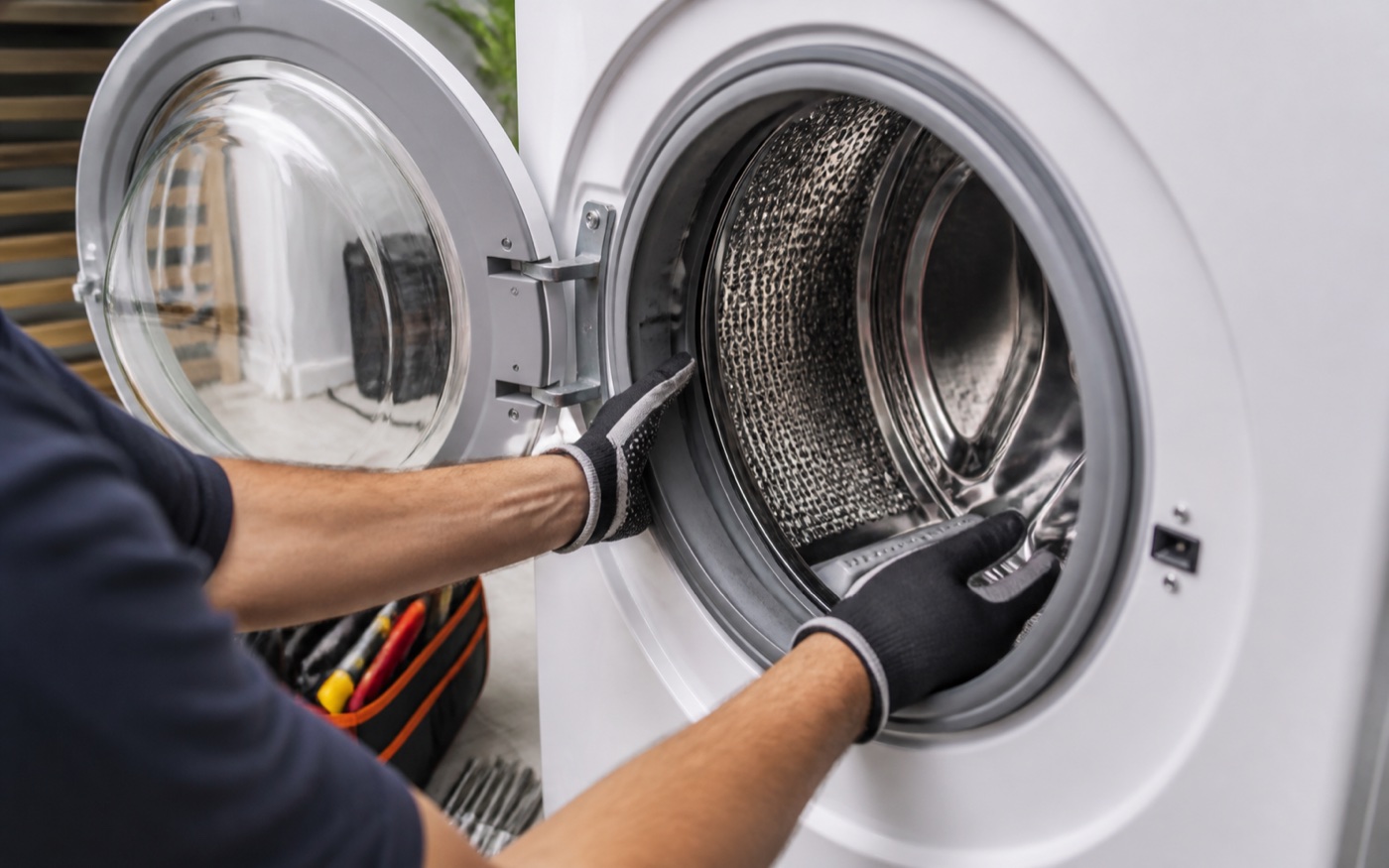
Diagnostic Photos
Local Washer Service
We provide washer repair in Cape Coral and Fort Myers, along with surrounding Southwest Florida service areas.
For scheduling, use the Contact page or call/text Art’s Appliance Repair directly.
Related Appliance Guides
Washer
Washer Not Spinning: What Could Be Wrong?
Washer not spinning or clothes still wet? Check cycle settings, drainage and load balance, then know what to share for washer repair in Cape Coral or Fort Myers.
Updated September 21, 2026
Washer Not Spinning
Washer
Washer Stops in the Middle of a Cycle: Common Causes
Washer stopping mid-cycle? Learn the common drain, lock, motor, sensor, water-supply, and control problems and when to schedule washer repair.
Updated August 6, 2026
washer stops in the middle of a cycle
Washer
Washer Not Draining: 7 Common Causes
Washer not draining or leaving water inside? Learn the common causes, safe checks, and when to schedule washer repair in Cape Coral or Fort Myers.
Updated July 25, 2026
Washer Not Draining: 7 Common CausesNeed service?
Washer Repair in Cape Coral, Fort Myers and Southwest Florida
Art’s Appliance Repair diagnoses washer vibration and spin problems throughout Cape Coral, Fort Myers, North Fort Myers, Lehigh Acres, Estero, Bonita Springs, Naples, and surrounding Southwest Florida communities.
We diagnose washer shaking violently during spin, washer walking across the floor, tub hitting the cabinet, worn suspension rods, front-load shock absorber problems, washer not balancing loads, loud spin-cycle noise, basket bearing problems, washer not completing spin, drain problems affecting spin, and basket or drive-system problems.
Call or text (239) 688-9955 to schedule washer service.
The service call is $0 when the diagnosed repair is approved and completed. If no repair is completed, the diagnostic service call is $79.
View Washer Repair