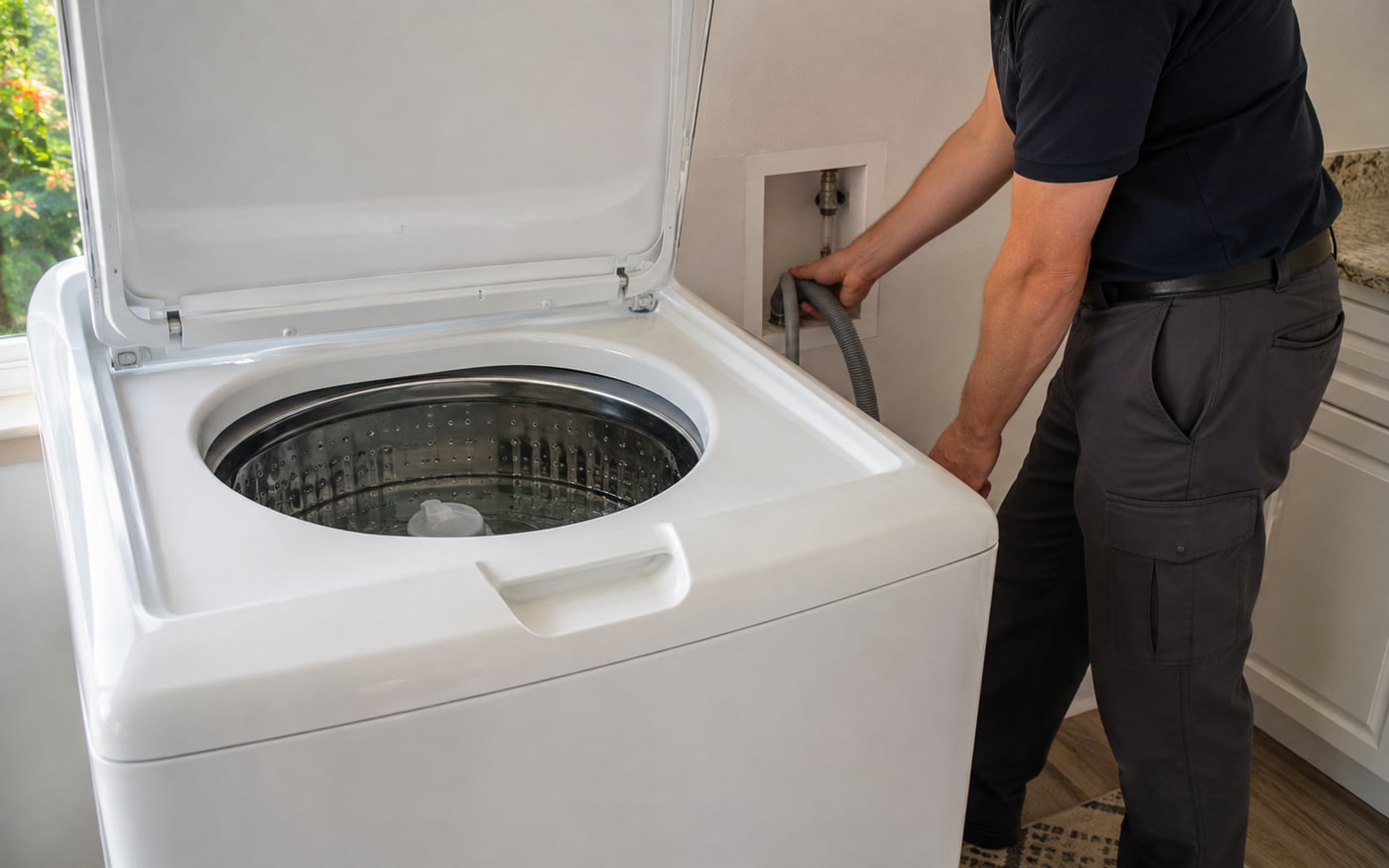
First: Is the Washer Siphoning or Is the Drain Pump Running?
This distinction is extremely important.
Water drains quietly while the washer is filling
If water seems to disappear without the normal drain-pump sound, the washer may be siphoning. Water is being pulled out through the drain hose by gravity and suction.
Whirlpool explains that a drain hose positioned too far into the standpipe, installed too low, or sealed without an air gap can cause water to be continuously siphoned from the machine.
You clearly hear the drain pump running
Now the machine itself may be intentionally draining.
- Fill error.
- Pressure or water-level error.
- Leak-protection routine on applicable models.
- Control command.
- Wiring problem.
- Model-specific fault response.
Whirlpool documents that some washers with an F8 E1 or LF fill error enter a several-minute pump-out routine. That is different from passive siphoning.
Cause #1: Drain Hose Is Too Far Down the Standpipe
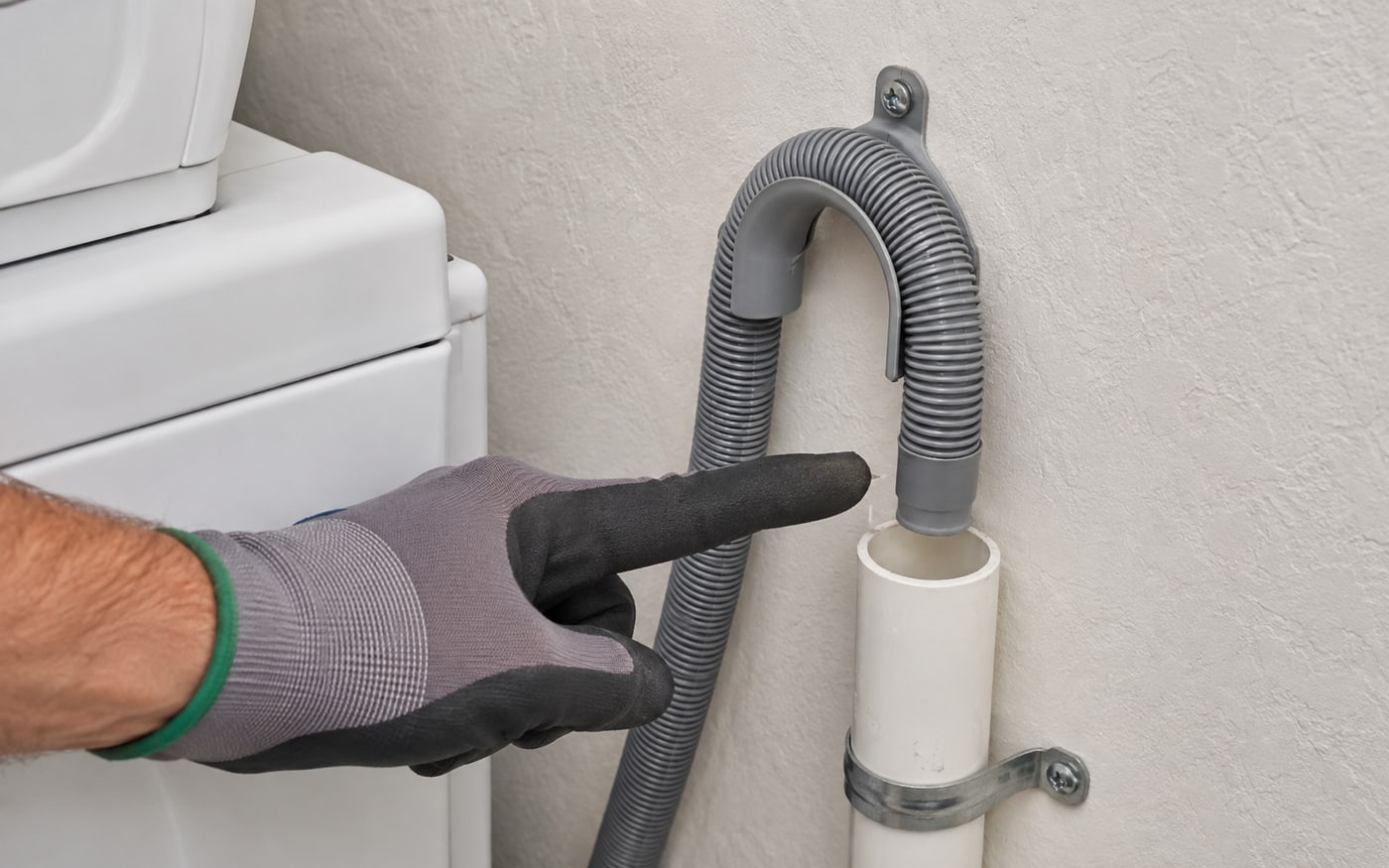
The drain hose should not simply be pushed as far as possible into the wall drain. If it extends too deeply, the drain system can create a siphon.
- The inlet valve opens and the washer begins filling.
- Water starts leaving through the drain hose.
- The control waits for the expected water level.
- The washer continues filling or eventually generates a fill error.
Whirlpool and Maytag warn that excessive drain-hose insertion can cause a washer to fill and drain simultaneously.
Cause #2: Drain Hose Is Sealed Into the Drainpipe
Taping the drain hose tightly into the standpipe may look secure, but a completely sealed drain connection can create suction. Manufacturer guidance says the hose should remain secure while still allowing an air gap around it.
- Do not wrap tape completely around the standpipe opening.
- Do not seal the hose with silicone.
- Do not pack rags tightly around it.
- Do not force a rubber plug around the hose.
The drain hose needs to be installed according to the washer’s installation instructions.
Cause #3: Standpipe Is Too Low
If the drain opening is too low, gravity can start pulling water out of the tub. Some Whirlpool and Maytag top-load guidance specifies minimum heights around 30 to 39 inches, while other washer designs can require something different.
Use the drain-height specification for the exact model rather than a universal measurement. This is especially important after washer replacement, moving the machine, remodeling the laundry room, changing the utility sink, or changing the standpipe.
Cause #4: Drain Hose Was Installed Incorrectly After Moving the Washer
If the problem began immediately after installation or relocation, inspect the drain system before assuming an internal component failed.
- Hose pushed farther down the standpipe.
- Hose lowered.
- U-shaped hose guide removed.
- Hose taped tightly into the drain.
- Standpipe configuration changed.
A washer that worked correctly before being moved and immediately began filling and draining afterward should raise suspicion of installation first.
Cause #5: The Washer Detected a Long-Fill Error
Sometimes the drain pump is running because the control wants it to run. On applicable Whirlpool washers, F8 E1, LF, or Lo FL can indicate that the expected amount of incoming water was not detected.
- The lid or door may lock.
- The washer may stop accepting commands temporarily.
- The drain pump may run for several minutes.
- The cycle may be cancelled.
That can look like the washer fills and immediately drains, even though the original problem began with water supply or water-level detection.
Cause #6: One of the Water Supplies Is Turned Off
Some washers require both hot and cold water supplies even when a cold-water cycle is selected. Certain models monitor both inlet supplies and can generate a fill error if the expected flow is not detected.
- Hot valve fully open.
- Cold valve fully open.
- Inlet hoses not kinked.
- No recent plumbing work.
- No supply valve accidentally closed.
Cause #7: Water Inlet Screens or Hoses Are Restricted
If water enters too slowly, the washer may decide that the expected fill level is not being reached.
- Kinked inlet hose.
- Partially closed valve.
- Clogged inlet screen.
- Weak household water supply.
- Failed inlet valve.
If the machine drains because it detected a fill fault, replacing the drain pump will not address the original problem.
Cause #8: Pressure Sensor or Water-Level System Problem
Depending on the design, the washer may use a pressure sensor, pressure hose, water-level switch, and electronic control to determine how much water is in the tub.
- Continue filling.
- Stop filling too early.
- Generate a fill error.
- Drain as a protective response.
- Behave inconsistently between cycles.
Do not replace a sensor based only on the symptom. First verify drain installation, water supply, inlet flow, and exact error codes.
Cause #9: The Drain Pump Is Being Powered When It Should Not Be
If the drain installation is correct and the pump clearly starts as soon as water enters, a technician needs to determine why the pump is receiving power.
- Control logic responding to an error.
- Water-level sensing problem.
- Wiring issue.
- Electronic control failure.
- Model-specific protection mode.
The pump does not decide when to run; it operates when the control circuit energizes it. Replacing a working drain pump can leave the same symptom.
Cause #10: Control Board Problem
A failed electronic control can potentially command the drain pump incorrectly, but the board should not be the first diagnosis.
- Drain-hose installation.
- Standpipe height and air gap.
- Water supply and inlet-valve operation.
- Error codes.
- Pressure-sensor system.
- Wiring.
Control boards are expensive, and many fill-and-drain complaints are installation-related.
Washer Keeps Filling While Water Goes Down the Drain
This is the classic siphoning pattern. Water may enter continuously, never reach the expected level, and leave without strong drain-pump noise before an LF or F8 E1 error appears. Inspect the drain hose first.
Washer Fills Normally, Then Pump Suddenly Starts Draining
If the washer fills to a normal-looking level, stops filling, and then the drain pump starts, passive siphoning becomes less likely. Look for an error code, lid or door issue, water-level fault, control response, or model-specific cancellation routine.
Washer Fills and Drains After an Error Code
Do not erase the error before writing it down. Photograph the complete code, blinking lights, and cycle indicators. Codes can help distinguish a plumbing problem from a control or sensor problem.
Use the Appliance Error Codes page as a starting point, but always verify the exact washer model.
Washer Drains for Several Minutes and Will Not Respond
Whirlpool documents that certain washers may enter an approximately 8–10 minute drain routine after an F8 E1 or Lo FL condition, during which normal control input may be limited.
- Do not repeatedly unplug the machine.
- Do not press every button.
- Do not repeatedly interrupt the drain routine.
Record the code and allow the model-prescribed routine to complete. If the fault returns, diagnose the cause.
New Washer Fills and Drains Immediately
If the washer is newly installed, check drain-hose insertion, standpipe height, air gap, hose routing, and water valves before ordering parts.
Washer Started Doing This After Plumbing Work
Inspect the drain system first if a utility sink or drainpipe was replaced, the washer was moved, the hose was rerouted, the laundry room was remodeled, the standpipe was shortened, or the drain connection was sealed.
Washer Fills but Does Not Start Washing
That is a different symptom. If the washer fills normally, keeps the water in the tub, and does not agitate or tumble, use the existing guide below. This article specifically owns the condition where water enters and then leaves the washer.
Washer Fills With Water but Does Not Start Washing
Washer Will Not Drain
This is nearly the opposite symptom. If water stays trapped inside the tub, the diagnostic path includes a blocked drain path, failed drain pump, clogged hose, or control problem.
Safe Checks You Can Do
Without opening energized panels, you can check:
- Drain-hose position.
- Whether the hose is sealed into the standpipe.
- Standpipe height against the exact installation instructions.
- Hot and cold water valves.
- Kinked inlet hoses.
- Visible error codes.
- Whether the drain pump can be heard.
- Whether water drains silently.
- Whether the problem began after installation or plumbing work.
- The washer model number.
These observations can dramatically shorten diagnosis.
What Not to Do
- Do not seal the drain hose tightly into the standpipe.
- Do not push the hose farther down to keep it from moving.
- Do not lower the drain hose to the floor.
- Do not replace the drain pump simply because water is leaving.
- Do not bypass the pressure sensor.
- Do not bypass lid or door safety circuits.
- Do not run diagnostic modes from another washer model.
- Do not repeatedly reset a washer that immediately returns the same error.
Exact installation and service specifications vary by model.
What a Technician Usually Checks
- Verify whether the washer is siphoning or the pump is running.
- Inspect hose depth, hose height, air gap, and standpipe.
- Verify hot and cold supply, inlet flow, and hose condition.
- Retrieve long-fill, water-level, and model-specific fault codes.
- Evaluate the pressure system, sensor, hose, and wiring.
- Determine whether the drain pump is being energized intentionally.
- Evaluate the electronic control only after installation, supply, sensing, and wiring are ruled out.
When Should You Schedule Washer Repair?
Professional diagnosis makes sense when:
- Drain installation is correct but the washer still drains during fill.
- The drain pump starts every time the washer fills.
- F8 E1, LF, Lo FL, or another fill error keeps returning.
- The washer immediately enters a long drain routine.
- Water-level readings appear incorrect.
- The symptom began without plumbing changes.
- Wiring or controls require access.
- The washer repeatedly cancels the cycle.
Tell the technician whether the pump audibly starts and pumps the water out or whether water drains quietly through the hose while the washer is still filling. Those descriptions point in different directions.
Frequently Asked Questions
Why does my washer fill and drain at the same time?
One common cause is siphoning through an incorrectly installed drain hose. A hose inserted too far, positioned too low, or sealed tightly into the standpipe can allow water to leave while the washer is filling.
How do I know if the washer is siphoning?
Listen to the machine. If water is leaving but you do not hear the normal drain-pump sound, siphoning becomes more likely. Check the drain-hose installation and model-specific standpipe requirements.
Can the drain hose be too far into the wall?
Yes. Manufacturer guidance warns that excessive drain-hose insertion can contribute to siphoning. Use the installation instructions for the exact washer.
Should the drain hose be sealed into the standpipe?
No. Manufacturer guidance calls for an air gap around the hose rather than an airtight seal because airflow helps prevent siphoning.
Why does my washer show F8 E1 and then drain?
On applicable Whirlpool models, F8 E1 indicates that the expected water fill was not detected. Some models then enter a several-minute drain routine.
Is the drain pump bad if the washer immediately drains?
Not necessarily. A working pump may be following a control command, or water may be siphoning without the pump running at all.
Can a pressure sensor cause a washer to drain?
A water-level sensing problem can contribute to incorrect fill detection on applicable models. It should be diagnosed along with drain installation, water supply, wiring, and error codes rather than replaced automatically.
Photo guide
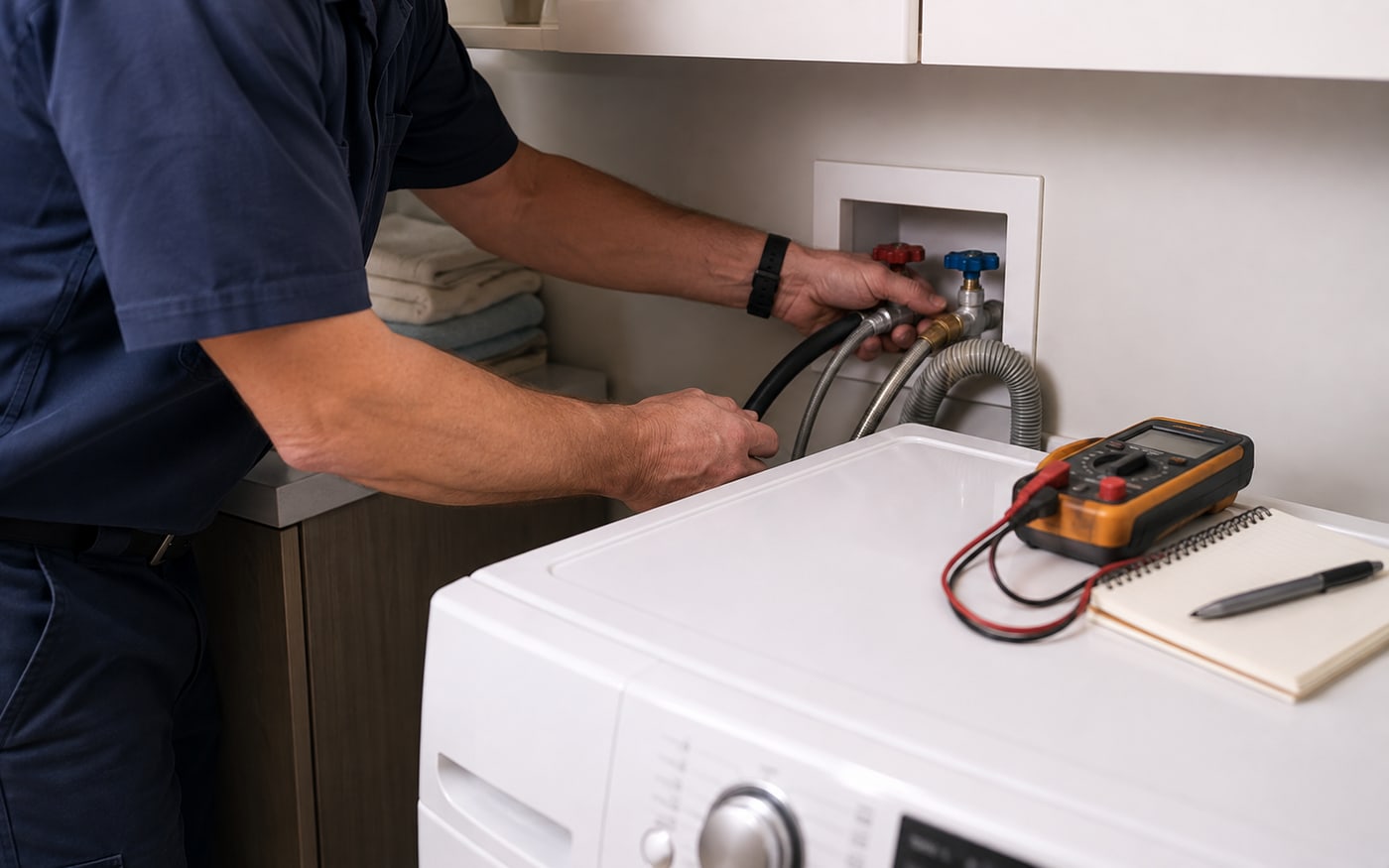
Diagnostic Photos
Local Washer Service
We provide washer repair in Cape Coral and Fort Myers, along with surrounding Southwest Florida service areas.
For scheduling, use the Contact page or call/text Art’s Appliance Repair directly.
Helpful Next Pages
These related guides and local service pages help connect the symptom to a practical repair path.
Related Appliance Guides

Washer
Washer Not Filling With Water: What to Check
Washer gets no water or fills too slowly? Separate normal sensing from a supply problem, record the right clues, and know when to request local washer repair.
Updated September 10, 2026
washer does not receive water
Washer
Washer Fills With Water but Does Not Start Washing: What It Usually Means
Washer fills but will not wash? Separate a normal sensing pause from lock, cycle, drain, drive and electrical warning signs before requesting local repair.
Updated September 23, 2026
washer fills but does not start washing
Washer
Washer Not Draining: 7 Common Causes
Washer not draining or leaving water inside? Learn the common causes, safe checks, and when to schedule washer repair in Cape Coral or Fort Myers.
Updated July 25, 2026
washer not drainingNeed service?
Washer Repair in Cape Coral, Fort Myers and Southwest Florida
Art’s Appliance Repair diagnoses washer fill, drain, spin, motor, pressure-sensor, control, and installation-related problems throughout Cape Coral, Fort Myers, North Fort Myers, Lehigh Acres, Estero, Bonita Springs, Naples, and surrounding Southwest Florida communities.
We diagnose washers that fill and drain at the same time, fill then drain immediately, keep filling without reaching wash, enter pump-out mode, show F8 E1, LF, or Lo FL, fail to drain, fail to spin, or fill but do not wash.
Call or text (239) 688-9955 to schedule service.
The service call is $0 when the diagnosed repair is approved and completed. If no repair is completed, the diagnostic service call is $79.
View Washer Repair