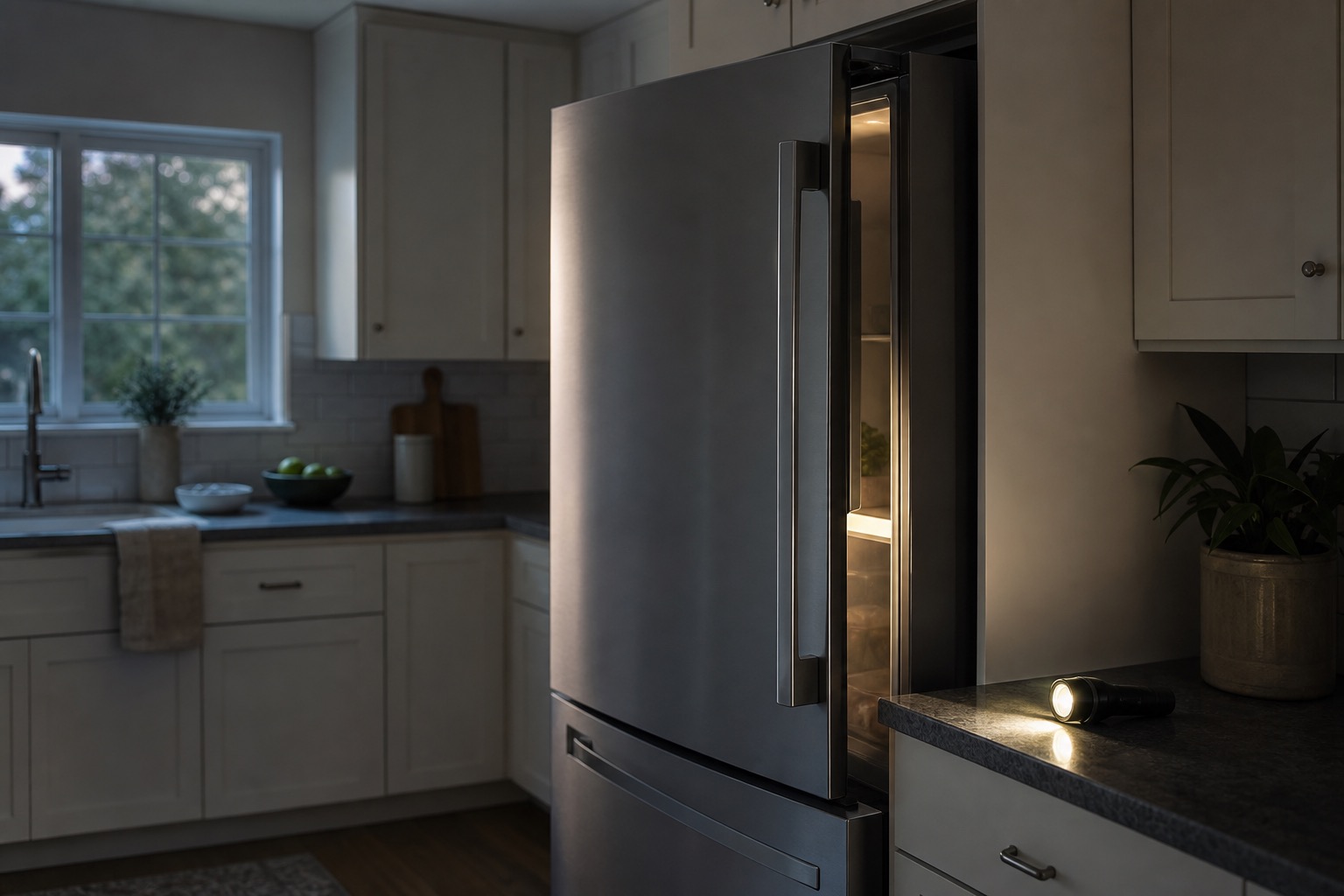
Do You Need to Wait Before Restarting a Refrigerator After an Outage?
There is no universal rule that every refrigerator must remain unplugged for a fixed number of hours after a normal household power outage.
Different manufacturers and models use different electronics, compressors, inverter controls, and reset procedures. In many situations, the refrigerator simply resumes operation when normal electrical service returns.
The important questions are whether electrical power is stable, the outlet is operating normally, the breaker is holding, the refrigerator is showing an error code, the appliance actually restarted, and whether the appliance stayed dry.
Compare PO, Cooling Off and Sabbath before changing refrigerator controls
Do Not Keep Unplugging and Reconnecting the Refrigerator
After a power outage, homeowners sometimes repeatedly unplug the refrigerator because they do not immediately hear the compressor. That can make diagnosis harder.
Modern refrigerators may delay compressor operation, run fans before the compressor, perform a self-check, display an error condition, or gradually ramp compressor speed.
Samsung specifically advises against unnecessary refrigerator resets because resetting can erase diagnostic information and error-code history.
Some Refrigerators May Need a Model-Specific Reset
A refrigerator that does not boot correctly after a power interruption may sometimes require a reset, but that reset should follow the manufacturer’s instructions for the actual model.
Samsung documents certain power-related conditions, including 88 88, 83E, 85E, and 86E, that can occur after power disruption, brownout, or surge conditions. Samsung’s general reset guidance says that when a reset is actually appropriate, disconnecting power for about five minutes may be used.
Do not turn one manufacturer’s reset instruction into a universal rule for every refrigerator brand.
How Do You Know if the Refrigerator Restarted Correctly?
Do not judge only by the interior light. The light can work while the cooling system does not.
- Interior lights and display operate normally.
- No unusual error code is flashing.
- Normal airflow eventually returns.
- The compressor eventually begins operating.
- Actual temperature trends downward over time.
The temperature trend is more useful than expecting the refrigerator to become cold immediately.
The Refrigerator May Be Running but Still Be Warm
This is normal immediately after a sufficiently long outage. The cabinet, shelves, food, drawers, and air inside may all have warmed.
Once power returns, the refrigerator has to remove that stored heat. Compressor running plus refrigerator still warm after 20 minutes does not automatically mean the appliance failed.
Look for a downward temperature trend and keep the doors closed while the appliance recovers.
How Long Does a Refrigerator Take to Cool After a Power Outage?
There is no exact recovery time that applies to every refrigerator. Recovery depends on how long power was off, room temperature, how warm the food became, refrigerator size, freezer load, door openings, refrigerator design, and whether a Fast Cool or Power Cool mode is available.
During recovery, keep the doors closed as much as possible. Opening the doors repeatedly to see if it is cold yet slows recovery.
Check the Actual Temperature, Not Just the Display
The control panel usually shows a set temperature or a sensor reading. That is not always the same thing as the temperature of every food item.
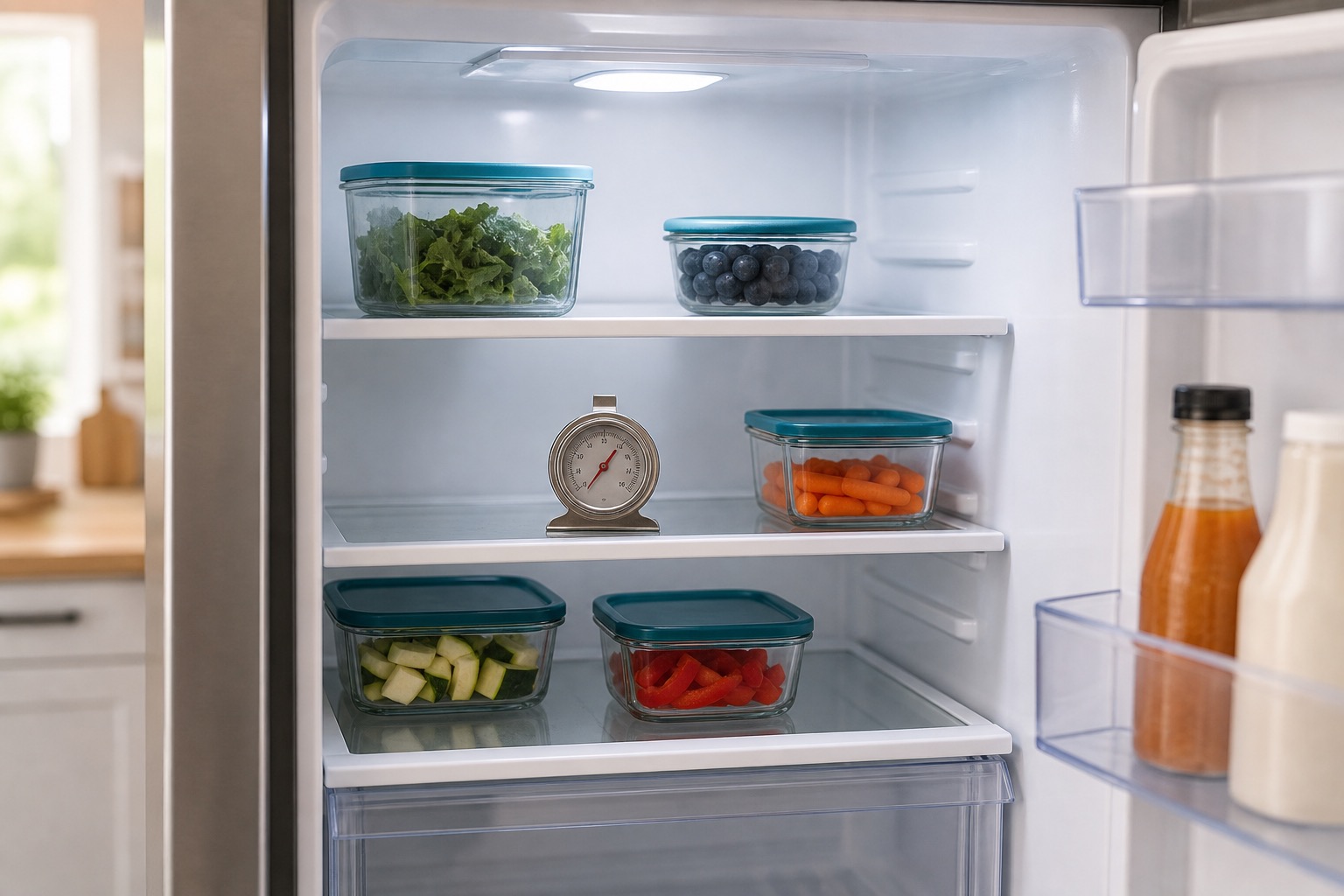
For food safety, FDA guidance says a refrigerator should normally be kept at 40 degrees F or below and a freezer at about 0 degrees F. Using an appliance thermometer makes outage decisions much easier.
After a serious outage, measuring temperature is safer than relying on how cold the shelf feels, whether the compressor is running, or whether the display says 37 degrees F.
Is Food Safe if the Refrigerator Was Off for Less Than Four Hours?
According to FDA guidance, refrigerated food should generally remain safe during an outage of about 4 hours or less if the refrigerator door stayed closed.
That is why one of the most useful things you can do during an outage is leave the refrigerator closed. Every door opening releases cold air and lets warm humid air inside.
What if the Refrigerator Was Without Power for More Than Four Hours?
Now food safety requires more caution. Perishable refrigerated foods can become unsafe after spending too much time above safe refrigeration temperatures.
- meat;
- poultry;
- seafood;
- milk;
- eggs;
- leftovers;
- many prepared foods.
FoodSafety.gov advises discarding refrigerated perishable foods after extended loss of safe refrigeration and warns not to taste food to decide whether it is safe. A refrigerator becoming cold again does not make unsafe food safe again.
Can Frozen Food Be Refrozen After an Outage?
Sometimes. FDA says frozen food can generally be safely refrozen or cooked if it still contains ice crystals or remains at 40 degrees F or below.
Quality may be reduced even when the food is considered safe to refreeze. Do not use appearance or smell alone to decide whether thawed food is safe.
How Long Does a Freezer Stay Cold Without Power?
With the door kept closed, a full freezer can generally maintain temperature for approximately 48 hours. A half-full freezer may maintain temperature for about 24 hours.
These are general FDA and USDA food-safety estimates, not guarantees for every freezer and every environment. A freezer in a hot Southwest Florida garage can behave differently from a freezer inside an air-conditioned home.
Should You Immediately Turn the Freezer to the Coldest Setting?
Usually there is no need to randomly change settings. First verify that cooling is operating, the doors seal, no error code is present, and freezer temperature is trending downward.
Some models provide Fast Freeze, Power Freeze, or Quick Freeze. Use those only according to the manufacturer’s instructions. Do not compensate for a refrigerator that is not cooling by simply setting the temperature lower.
What if the Refrigerator Is Beeping After the Outage?
A warm refrigerator may trigger a high-temperature alarm. A blinking temperature display or alarm can occur while a refrigerator is recovering because the compartment temperature is still high.
If temperature is steadily dropping, the alarm may stop once normal conditions return. If temperature does not decrease, error codes appear, the compressor repeatedly clicks, or fans do not operate, continue diagnosis instead of assuming the alarm is only recovery.
Refrigerator Lights Work but It Is Not Cooling
Interior lights prove only that some electrical power is reaching the refrigerator. They do not prove that the compressor, inverter, evaporator fan, condenser fan, cooling mode, or main control is operating correctly.
Use the Refrigerator Not Cooling After a Power Outage guide for that symptom.
Compressor Clicks but Does Not Start
After a power event, a refrigerator may begin click, hum, click and repeat later. That is different from a refrigerator that is simply taking time to cool.
Possible diagnostic areas include start components, inverter control, compressor condition, control output, and incoming electrical conditions. If the pattern continues instead of transitioning to normal operation, schedule diagnosis.
Cooling Off or Demo Mode After a Power Event
Some refrigerators can appear completely operational while cooling is disabled. You may see OF OF, O FF, Cooling Off, Demo, or another model-specific indication.
Check the manufacturer’s instructions before ordering parts. A cooling mode issue is not the same as a failed sealed system.
Error Codes After Power Is Restored
Power restoration can sometimes reveal a fault immediately. Record the full code, blinking segments, which compartment is affected, whether the compressor starts, and whether the code returns after the manufacturer-approved reset.
Use our Appliance Error Codes guide before clearing the display.
When Should You Not Restart the Refrigerator?
Do not energize the appliance when there is an obvious electrical or water-safety concern.
- appliance was submerged in floodwater;
- water entered electrical components;
- outlet is wet;
- power cord is damaged;
- plug is burned or melted;
- breaker immediately trips;
- smoke or electrical burning smell is present.
Hurricane Power Outage vs Flood Damage
Power outage only
The refrigerator lost power but remained dry. Main concerns are food temperature, correct restart, cooling recovery, and possible surge-related symptoms.
Floodwater reached the refrigerator
Now possible concerns include electrical shock, contaminated insulation, inaccessible contamination, damaged wiring, and corrosion. Do not treat this like a normal household outage.
What About a Power Surge?
If the refrigerator worked before the outage and develops a new electrical symptom immediately after power restoration, note the timing.
- repeated control resets;
- voltage-related codes;
- compressor will not start;
- display abnormality;
- breaker trips;
- burning smell.
Do not assume power surge automatically means bad control board. The failed circuit still needs to be diagnosed.
Read: Appliances After a Power Surge: Warning Signs of Damage.
What About the Ice Maker?
Ice production is usually one of the last refrigerator functions to fully recover. The freezer first needs to become cold enough.
If the refrigerator and freezer have fully recovered but ice production does not resume, focus on freezer temperature, water flow, ice maker status, test behavior, and airflow.
Read: Ice Maker Not Working After a Power Outage.
Why Keeping the Doors Closed Matters After Power Returns Too
Door discipline is not only important during the outage. It matters during recovery.
- warm air enters;
- humidity enters;
- the compressor gets more heat to remove;
- frost can form;
- recovery takes longer.
If you are monitoring recovery, use an appliance thermometer rather than opening the refrigerator every few minutes.
Heavy Frost After a Power Outage
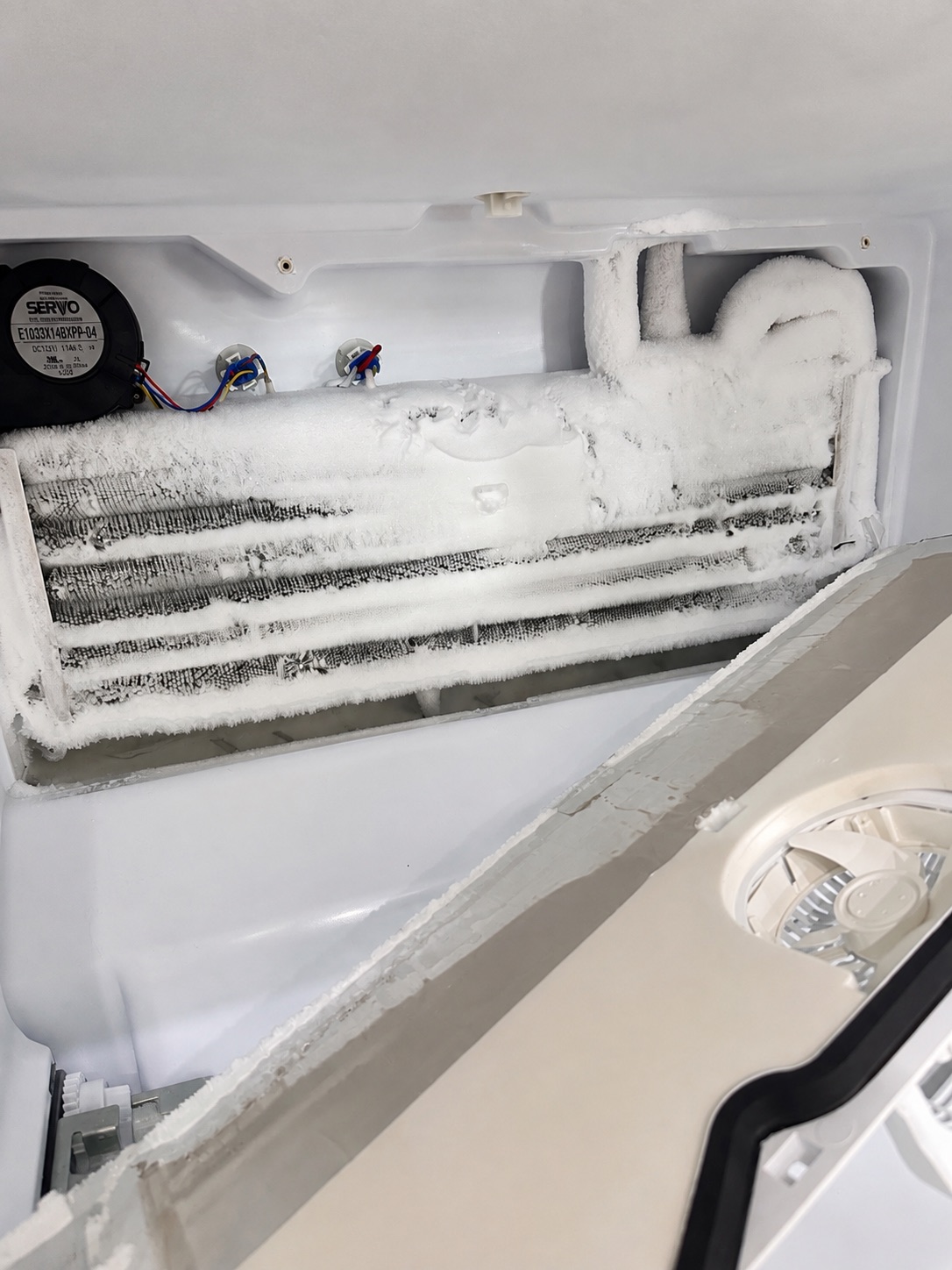
After a prolonged outage, warm humid air may enter when doors are opened repeatedly. As the refrigerator cools again, moisture can freeze on food packages, walls, vents, and the evaporator area.
A one-time frost event after a door was left open does not automatically prove a defrost-system failure. But if heavy rear-wall frost returns repeatedly after a complete defrost, investigate further.
Read: Why Is My Freezer Building Up Too Much Frost?
When Is It Safe to Put New Groceries Back In?
Do not use the fact that the compressor is running as the standard. Use temperature.
For normal refrigerated food storage, FDA recommends the refrigerator be at 40 degrees F or below. For normal freezer storage, target approximately 0 degrees F.
If the refrigerator is still 55 degrees F and slowly cooling, it is not yet ready to safely hold new perishable groceries for normal storage.
A Practical Post-Outage Checklist
- Confirm household electrical service is stable.
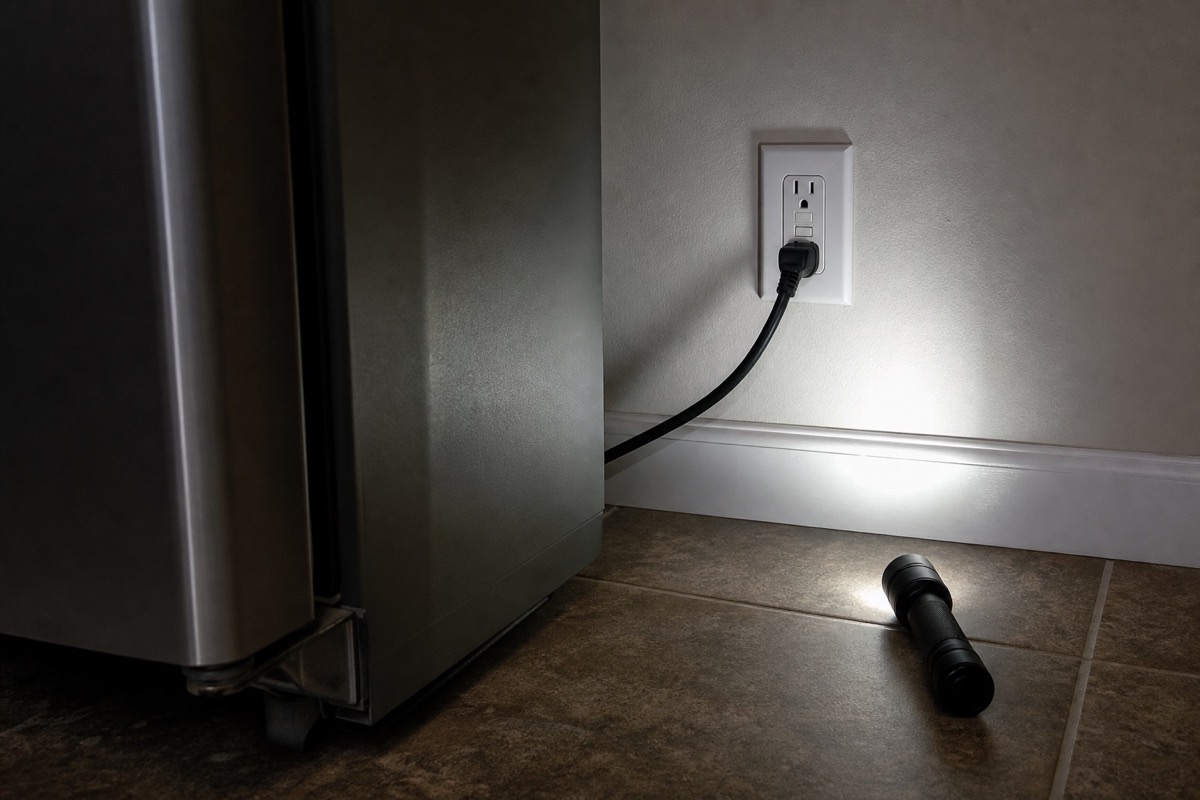
- Inspect the plug, cord, and accessible outlet.
- Restore normal refrigerator operation.
- Photograph any error codes.
- Keep doors closed.
- Verify that temperature is decreasing.
- Use appliance thermometers if available.
- Evaluate refrigerated food separately.
- Evaluate frozen food separately.
- Do not restart a flood-exposed appliance.
- Do not repeatedly power-cycle a refrigerator that is not cooling.
- Schedule service if temperatures are not recovering normally.
Useful Example: Normal Recovery
Power was off for two hours. The refrigerator doors stayed closed. When electricity returns, lights come on, the compressor eventually starts, no error codes appear, and refrigerator temperature begins dropping.
That is generally a normal recovery pattern. The refrigerator does not need to become instantly cold before you can conclude that it restarted.
Another Example: Refrigerator Powers Up but Does Not Cool
Power returns. Lights work. Display looks normal. Four hours later, the refrigerator remains warm, the freezer remains warm, airflow is weak, or the compressor is not operating normally.
Now this is no longer only a food-safety waiting period. The appliance itself needs diagnosis.
Another Example: Freezer Food Is Partially Thawed
The freezer begins cooling normally after the outage, but some food has softened. Do not decide based on the fact that the freezer is now running.
FDA guidance says frozen food that still contains ice crystals or remains at 40 degrees F or below can generally be refrozen or cooked. Food that exceeded safe temperatures requires a different decision.
What We Look at During a Service Call
For a refrigerator problem after an outage, the sequence matters. We separate food-safety questions, power-supply questions, control boot behavior, cooling operation, actual temperature recovery, and surge-related symptoms.
Those questions should not be collapsed into: the fridge was off, so it needs a new board.
When Should You Call a Refrigerator Technician?
Schedule diagnosis when:
- refrigerator has power but does not begin cooling;
- temperature stops improving;
- compressor repeatedly clicks but does not run;
- breaker repeatedly trips;
- voltage or power error returns;
- refrigerator only operates after repeated resets;
- fan does not operate;
- one compartment cools but the other remains warm;
- freezer will not return to freezing temperature;
- refrigerator develops a new abnormal sound after restoration;
- burnt smell or electrical damage is present.
If you already know the outage duration and measured temperatures, provide that information to the technician.
Official Food-Safety and Manufacturer References
For food decisions after an outage, use current FDA and FoodSafety.gov guidance. Manufacturer reset and error-code steps should be checked by brand and model before clearing codes.
FDA: Food and Water Safety During Power Outages and Floods
FoodSafety.gov: Food Safety During Power Outage
Samsung: How to Reset Your Samsung Refrigerator
Samsung: Refrigerator Error Codes
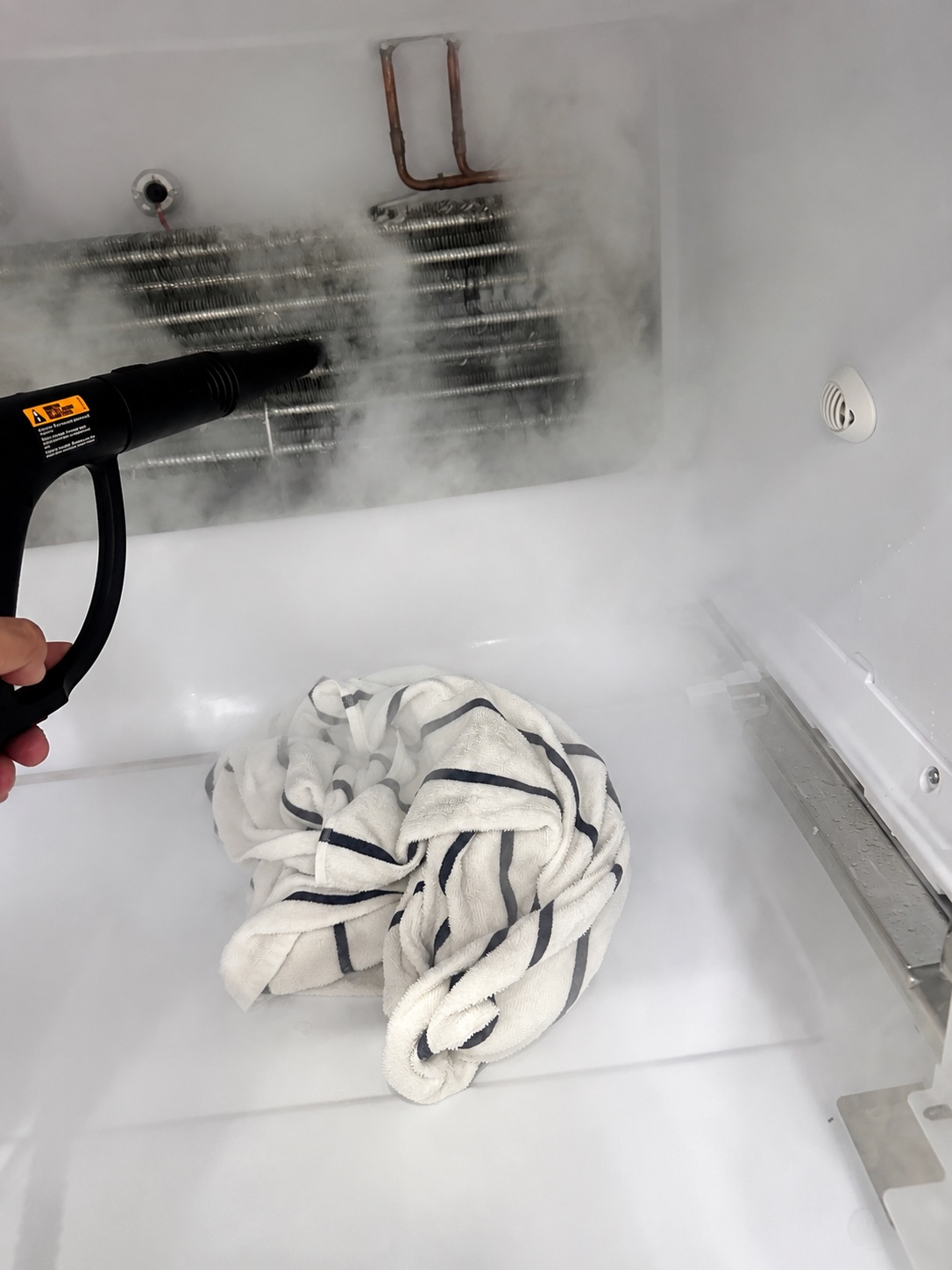
Photo guide
Diagnostic Photos
Local Refrigerator Service
We provide refrigerator repair in Cape Coral and Fort Myers, along with surrounding Southwest Florida service areas.
For scheduling, use the Contact page or call/text Art’s Appliance Repair directly.
Helpful Next Pages
These related guides and local service pages help connect the symptom to a practical repair path.
Related Appliance Guides
Refrigerator
Refrigerator Not Cooling After a Power Outage: What to Check
Refrigerator warm after a power outage? Separate PO from Cooling Off, protect food, and know when to request refrigerator repair in Cape Coral or Fort Myers.
Updated September 21, 2026
Refrigerator Not Cooling After a Power Outage
Appliance Tips
Appliances After a Power Surge: Warning Signs and Safe Next Steps
Appliance acting differently after a surge, outage, or Florida storm? Separate a home electrical problem from one appliance symptom and know when to stop and request service.
Updated October 18, 2026
appliances after a power surge
Ice Maker
Ice Maker Not Working After a Power Outage: What to Check
Ice maker stopped after a power outage? Check freezer temperature, water supply, reset behavior, airflow, error codes, and when to schedule repair.
Updated August 21, 2026
ice maker not working after a power outageNeed service?
Refrigerator and Freezer Repair After Power Outages in Southwest Florida
Art’s Appliance Repair diagnoses refrigerator and freezer problems after power outages, storms, and electrical interruptions throughout Cape Coral, Fort Myers, North Fort Myers, Lehigh Acres, Estero, Bonita Springs, Naples, and surrounding Southwest Florida communities.
We diagnose refrigerator not cooling after an outage, freezer not freezing after power restoration, compressor not restarting, fan and airflow problems, refrigerator power and communication errors, ice maker problems after outages, excessive frost after power restoration, and power-surge-related appliance symptoms.
Call or text (239) 688-9955 to schedule service.
Service call: $0 with an approved repair. $79 if no repair is completed.
View Refrigerator Repair