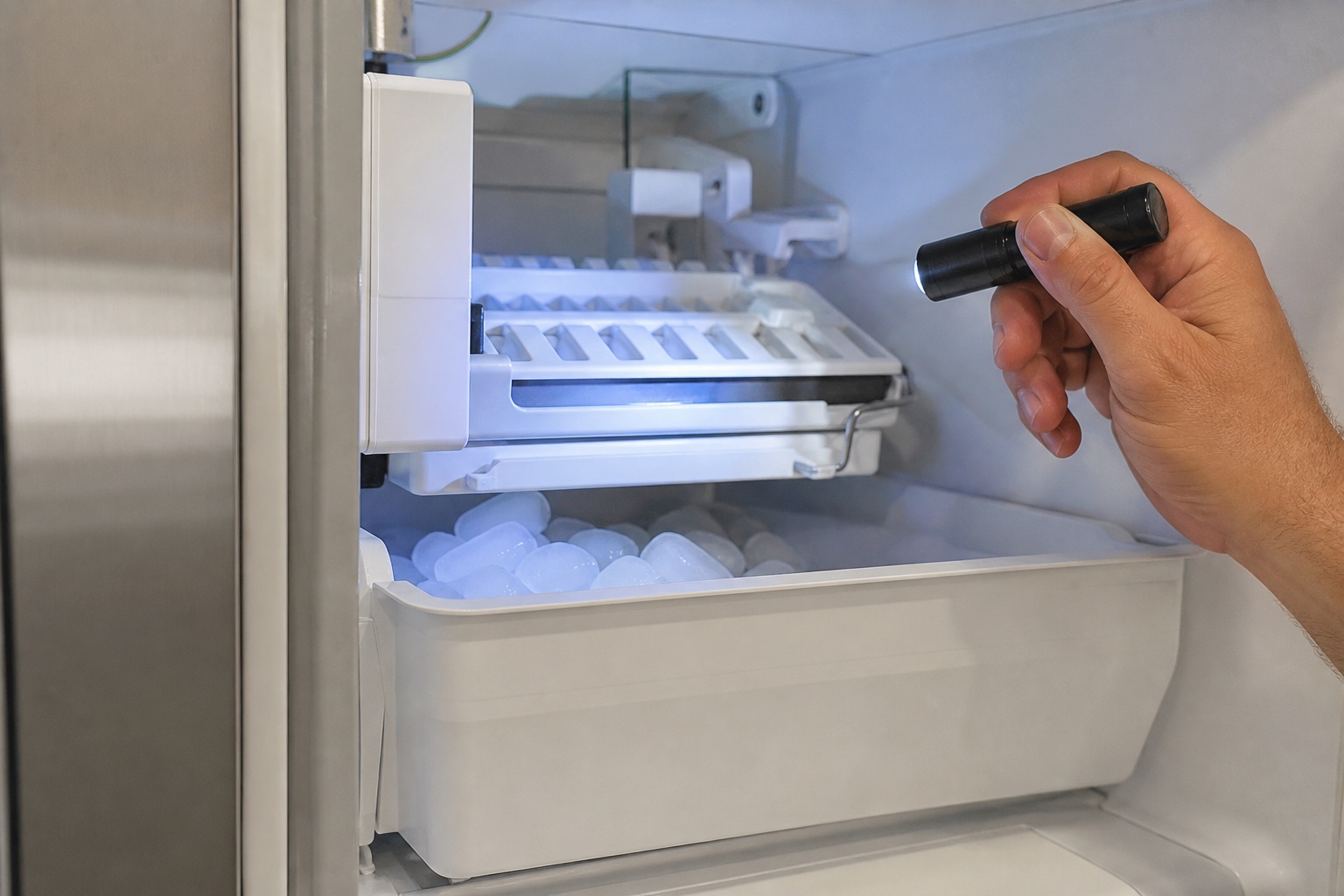
What Does a Successful Ice Maker Test Actually Prove?
A forced test can provide useful information, but it should not be treated as a complete diagnosis.
Depending on the refrigerator and ice-maker design, a test cycle may command tray movement, harvest motor operation, ejector movement, water fill, position sensing, and a completion chime or status indication.
If the tray rotates correctly during the test, you have learned something important: the mechanism is capable of moving when it receives a forced command.
But you have not yet proven that the refrigerator is giving that command during normal operation.
Test Mode Bypasses Part of the Waiting Process
Normal ice production is not continuous. The refrigerator has to wait until operating conditions are appropriate before beginning another harvest cycle.
That is why a forced test can appear successful even when automatic production is not occurring.
For example, the ice maker may physically be able to rotate, but normal production can still be affected by:
- temperature;
- water availability;
- ice-maker ON/OFF status;
- ice-level detection;
- refrigerator operating conditions.
This is why a working test cycle should narrow the diagnosis rather than end it.
First Question: Is the Ice Maker Actually Cold Enough?
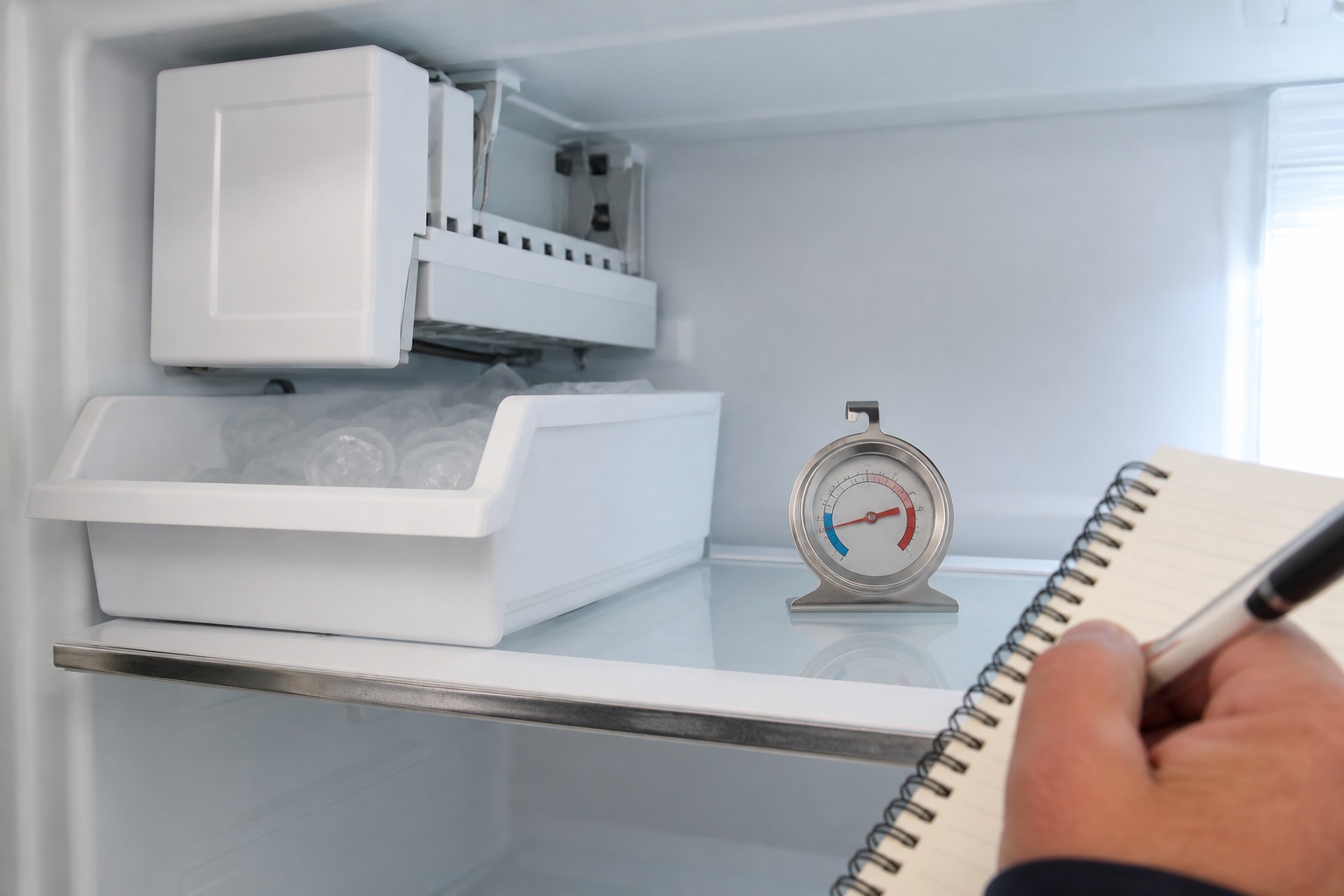
Temperature is one of the first things to verify. An ice maker cannot reliably produce and harvest ice if the freezer or dedicated ice compartment is too warm.
Many refrigerator ice makers need the freezer near 0°F (-18°C) for normal operation. Do not rely only on the display because the set temperature is not always the actual temperature around the ice maker.
This distinction becomes especially important on French-door refrigerators where the upper ice maker may be located in a separate ice compartment inside the fresh-food section.
A Test Cycle Can Work Even if Ice Is Not Freezing Fast Enough
Imagine that you manually run a test and the ice maker rotates, returns to its home position, and fills with water.
That proves several useful things. But if the water never becomes cold enough for the refrigerator to recognize that it is ready for harvest, another automatic cycle may never happen as expected.
This is one reason a technician should not immediately replace an ice maker simply because the test works but it does not make ice.
Look at What Happens During the Test
Do not treat "it passed the test" as a single result. Break it into individual steps.
Does the tray or ejector move?
If yes, the harvest mechanism can at least respond during the forced cycle.
Does it return to its normal position?
If it does not return correctly, the problem may still be inside the ice-maker assembly.
Does water enter the tray?
If the mechanism cycles but you never hear or see a water fill, investigate the water side separately.
Does it fill with the correct amount of water?
A very small fill points in a different direction than no fill at all.
Does the test complete normally?
Listen for the normal completion indication described for your particular model. The exact sequence varies by manufacturer and model, so model-specific service information matters.
If Test Mode Fills With Water, the Diagnosis Changes
Suppose the forced test causes the tray to rotate and then water enters normally. That means the refrigerator was capable of opening the water path under that forced condition.
You should then put more attention on questions such as:
- Is the compartment cold enough?
- Is the ice maker being enabled during normal operation?
- Is the bin-full system stopping production?
- Is the normal harvest command occurring?
- Is there an intermittent sensor or control problem?
You should not automatically assume that the water inlet valve is the cause simply because there is no ice during normal operation.
If Test Mode Does Not Fill With Water
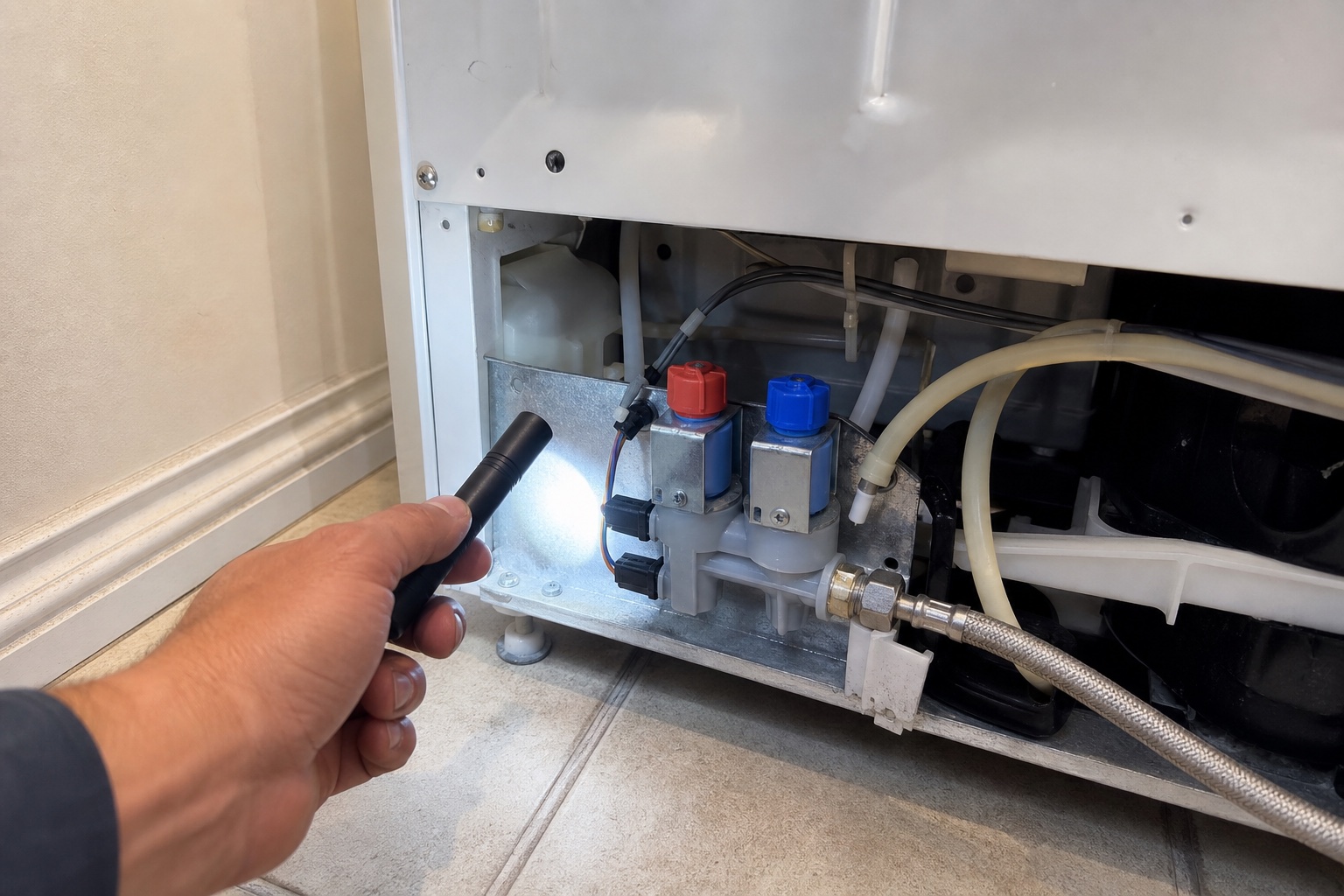
Now the water system deserves more attention. Check whether the refrigerator’s water dispenser has normal flow, if the model has one.
A restriction can come from:
- water supply;
- shutoff valve;
- filter;
- frozen fill path;
- inlet valve;
- model-specific water controls.
A functioning dispenser does not prove every ice-maker water component is good, but it is useful diagnostic information.
Check the Water Filter Before Ordering Parts
A water filter can cause more than just poor-tasting water. Restricted flow may produce small cubes, hollow cubes, low ice production, no ice, or slow water dispensing.
This becomes especially relevant when the problem began soon after replacing the filter, removing and reinstalling a filter, installing a non-original replacement, or turning the water supply off and back on.
Do not automatically replace the inlet valve without considering water-flow restrictions first.
Is the Ice Maker Turned On?
This sounds obvious, but electronic refrigerators can make it less obvious than expected.
Depending on the model, ice production may be controlled by:
- a physical switch;
- a control arm;
- an electronic Ice On/Off setting;
- a control-panel menu;
- separate settings for multiple ice makers.
A forced diagnostic function and the refrigerator’s normal ice-production setting are not always the same thing. Verify that the correct ice maker is enabled.
Check the Ice Bin and Ice-Level System
The refrigerator needs some way to know when the ice bin is full. Depending on the design, this may involve a mechanical shutoff arm, optical sensing, an electronic sensor, or a model-specific bin-detection system.
The ice maker itself may successfully complete a manual test while normal production remains disabled because the refrigerator thinks the bin is full.
Make Sure the Ice Bucket Is Installed Correctly
Do not overlook the bucket. A misaligned bucket can interfere with ice-level sensing, dispenser operation, mechanical engagement, or normal ice storage.
If the problem began after removing the bucket for cleaning or clearing a jam, inspect its position carefully.
Door and Compartment Conditions Matter
Some refrigerators use door switches and other operating conditions as part of normal refrigerator logic.
Diagnosis should include whether the door closes fully, whether the refrigerator recognizes the door position correctly, whether the ice compartment receives cold airflow, whether there is excessive frost around the compartment, and whether the gasket seals.
The exact relationship between door inputs and ice-maker operation varies by model, so do not bypass or permanently defeat a door switch as a troubleshooting shortcut.
Upper Ice Makers Need Special Attention
French-door refrigerators with an upper ice maker can create a misleading situation. The freezer may be perfectly cold while the upper ice compartment is too warm.
That can happen because of cold-air delivery problems, an ice-room fan issue, frost or ice blocking airflow, compartment sealing trouble, or model-specific ducting and controls.
When an upper ice maker passes a mechanical test but does not produce ice normally, measuring only the lower freezer temperature may not tell the entire story.
Test Mode Works After a Reset, Then the Problem Returns
Sometimes a customer reports: "Every time I reset it, it makes ice once. Then it stops again." That is different from an ice maker that never responds at all.
If a reset temporarily restores operation, document exactly what happens afterward:
- Does it make one batch?
- Does it fill once but never harvest?
- Does it harvest once but never refill?
- Does it stop after several hours?
- Does the ice compartment temperature change?
- Does an error code appear?
A temporary response to reset is information, not proof that the repair is complete.
Do Not Keep Pressing the Test Button
Repeated test cycles can create a new problem. If water is already in the tray and Test is activated repeatedly, the ice maker may receive another fill command depending on the design.
Run the manufacturer-specified test once and observe the entire sequence. Write down what happened. That is much more useful than repeatedly resetting the refrigerator.
The Ice Maker May Not Be the Failed Part
This is the biggest diagnostic mistake with this symptom. A customer sees no ice and assumes the ice maker itself is bad.
But if the ice maker can complete its forced mechanical cycle, the rest of the refrigerator has to be considered.
Depending on the model and symptoms, diagnosis may involve:
- compartment temperature;
- ice-room airflow;
- water flow;
- filter restriction;
- ice-level sensing;
- door inputs;
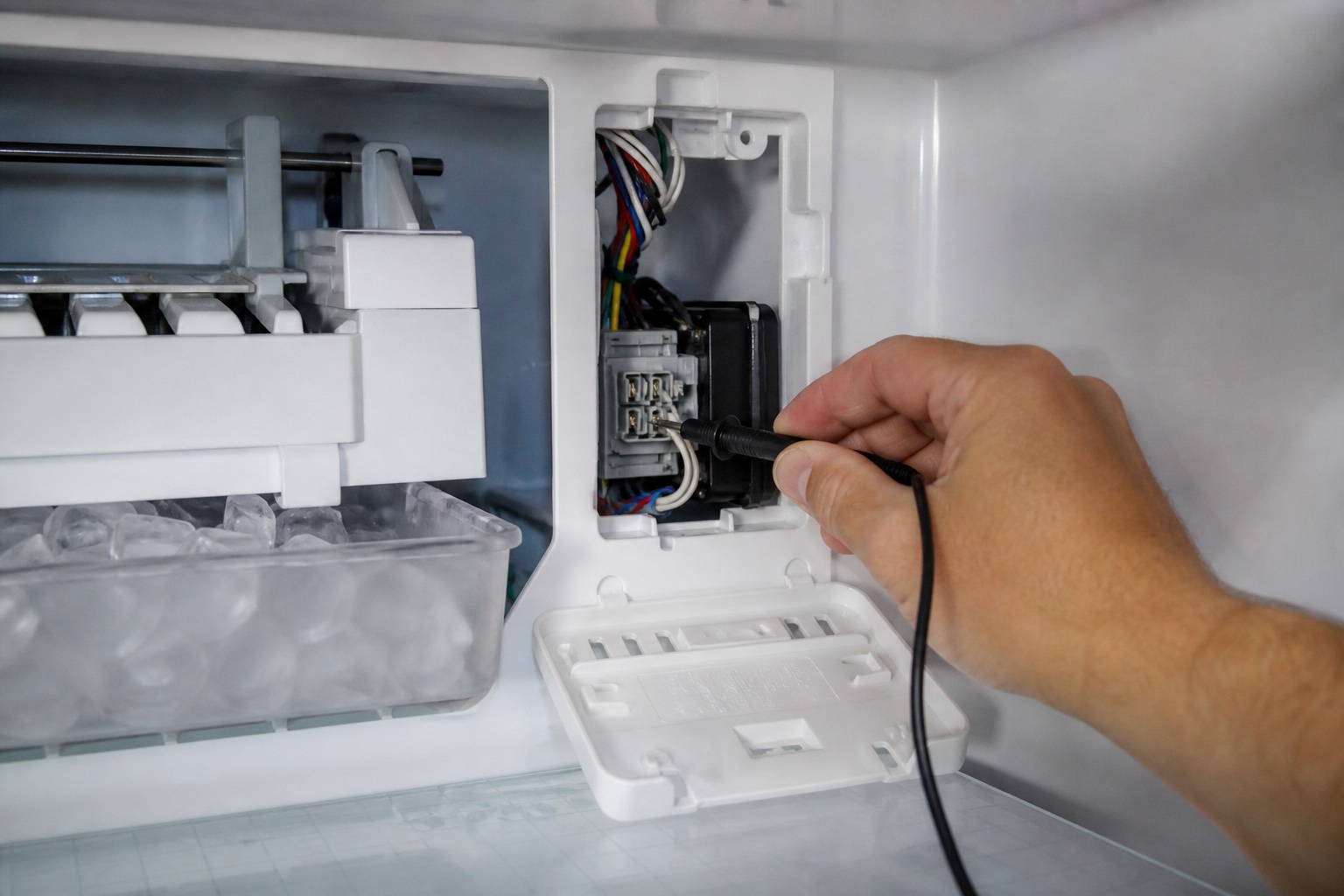
- wiring;
- temperature sensing;
- control logic;
- the ice maker itself.
Replacing the ice maker without determining which normal condition is missing can result in the exact same symptom with a new part installed.
What We Look for During a Service Call
When an ice maker works in Test Mode but not normally, the diagnostic order matters.
- Verify actual temperature, not just the setting.
- Verify ice-maker ON/OFF status, especially on models with multiple ice makers.
- Observe one complete test cycle and note whether it moves, returns home, requests water, and fills.
- Check water flow, especially when fill is weak or absent.
- Inspect the bin and ice-level system so normal production is not being intentionally stopped.
- Check the ice compartment, especially on upper French-door ice makers.
- Check for stored error codes before resetting the refrigerator.
- Only then decide which component needs further testing.
This prevents a working component from being replaced simply because the refrigerator is not producing ice automatically.
Test Works, but the Tray Never Fills Normally
If the forced test fills the tray but you never observe another normal fill, that is valuable information. The water system demonstrated that it can supply water during the test.
The next question becomes: why is the normal cycle not requesting that fill?
That can require model-specific diagnosis of sensing and control inputs rather than immediately replacing the water valve.
Test Works, Water Fills, but Ice Never Dumps
Now focus on what happens after the water freezes.
Questions include:
- Is the water actually freezing solid?
- Is the compartment temperature stable?
- Does the ice maker ever attempt an automatic harvest?
- Is there an error code?
- Does another manual Test immediately harvest the frozen cubes?
If the cubes are fully frozen and another forced test ejects them correctly, the mechanism is capable of harvesting, but something prevented the automatic harvest from being initiated.
That is a different diagnostic path from a seized ice-maker motor.
Test Works, but No Water Enters
If the tray completes its motion but stays dry, investigate water supply, filter restriction, frozen fill tube, inlet valve, wiring, or control to the valve.
Do not use sharp objects to clear a frozen fill tube. Damage to plastic tubing, wiring, or nearby refrigerator components can create a much larger repair.
What if the Water Dispenser Works?
Good dispenser flow is useful, but it does not prove that the entire ice-maker water circuit is operating correctly.
The dispenser and ice maker may share portions of the incoming water system while using different downstream valves or paths depending on refrigerator design.
Treat good dispenser flow as one diagnostic data point: the refrigerator has at least some incoming water pressure and flow. Continue testing the ice-maker side if the tray remains dry.
What if the Cubes Are Small or Hollow?
Small or hollow cubes often point toward an incomplete water fill rather than a harvest problem.
If Test Mode produces only a small amount of water, investigate water flow before blaming the harvest mechanism.
What if There Are Two Ice Makers?
Diagnose them separately. One working ice maker does not prove that the second unit, its compartment, or its controls are functioning normally.
Record which ice maker is failing, which one passes Test, whether both receive water, and whether both compartments are at the appropriate temperature.
Check Error Codes Before Replacing Parts
Modern refrigerators may store faults related to ice-maker operation, ice-room fans, temperature sensing, communication, defrost, door inputs, or sensor conditions.
If the refrigerator provides a diagnostic mode, record the codes before resetting or unplugging it whenever practical. A code does not automatically identify the failed part, but it may tell you which system deserves attention first.
View the Appliance Error Codes guide
When Does the Ice Maker Itself Become More Suspicious?
The ice maker remains a possible cause. It becomes more suspicious when:
- the forced cycle does not complete correctly;
- the tray stalls;
- the mechanism does not return home;
- test results are inconsistent;
- the assembly reports a model-specific fault;
- wiring and required inputs are correct but the assembly still does not respond normally.
The important point is not that the ice maker can never fail. It is that passing one forced test is not enough evidence to decide the entire system is good or bad.
A Useful Diagnostic Example
Consider this situation: the ice maker is empty, you press Test, the tray rotates normally, you hear the water valve, the tray receives water, and the test completes.
Several hours later, the water is frozen, but the ice maker still never harvests automatically. That pattern is more informative than simply saying the ice maker does not work.
You now know that the mechanism can rotate, the ice maker can reach the fill stage, water can enter, and the tray can freeze water. The missing event is the normal automatic harvest.
Another Example: Test Runs but the Tray Stays Dry
Now consider a different pattern: Test starts, the tray rotates, it returns home, you hear either no valve activity or only a brief sound, and no water enters.
In that case, there is little reason to focus first on whether the cubes are cold enough to harvest. The missing event is the water fill.
That sends the diagnosis toward water supply, filter, fill tube, valve, wiring, or model-specific control of the fill circuit.
When Should You Schedule Refrigerator Service?
Professional diagnosis is appropriate when:
- the ice maker repeatedly passes Test but never produces ice automatically;
- the tray moves but never fills;
- the tray fills but never harvests automatically;
- the upper ice compartment is too warm;
- the ice maker works only immediately after resetting;
- a fan or ice-room error appears;
- the fill tube repeatedly freezes;
- water flow is normal but the ice maker still does not operate;
- the problem returns after an ice-maker replacement;
- the refrigerator has multiple interacting ice-maker or control faults.
The test result is useful information to give the technician. Instead of saying only, "My ice maker doesn’t work," tell them, "It completes Test Mode and fills with water, but it never harvests automatically."
Photo guide
Diagnostic Photos
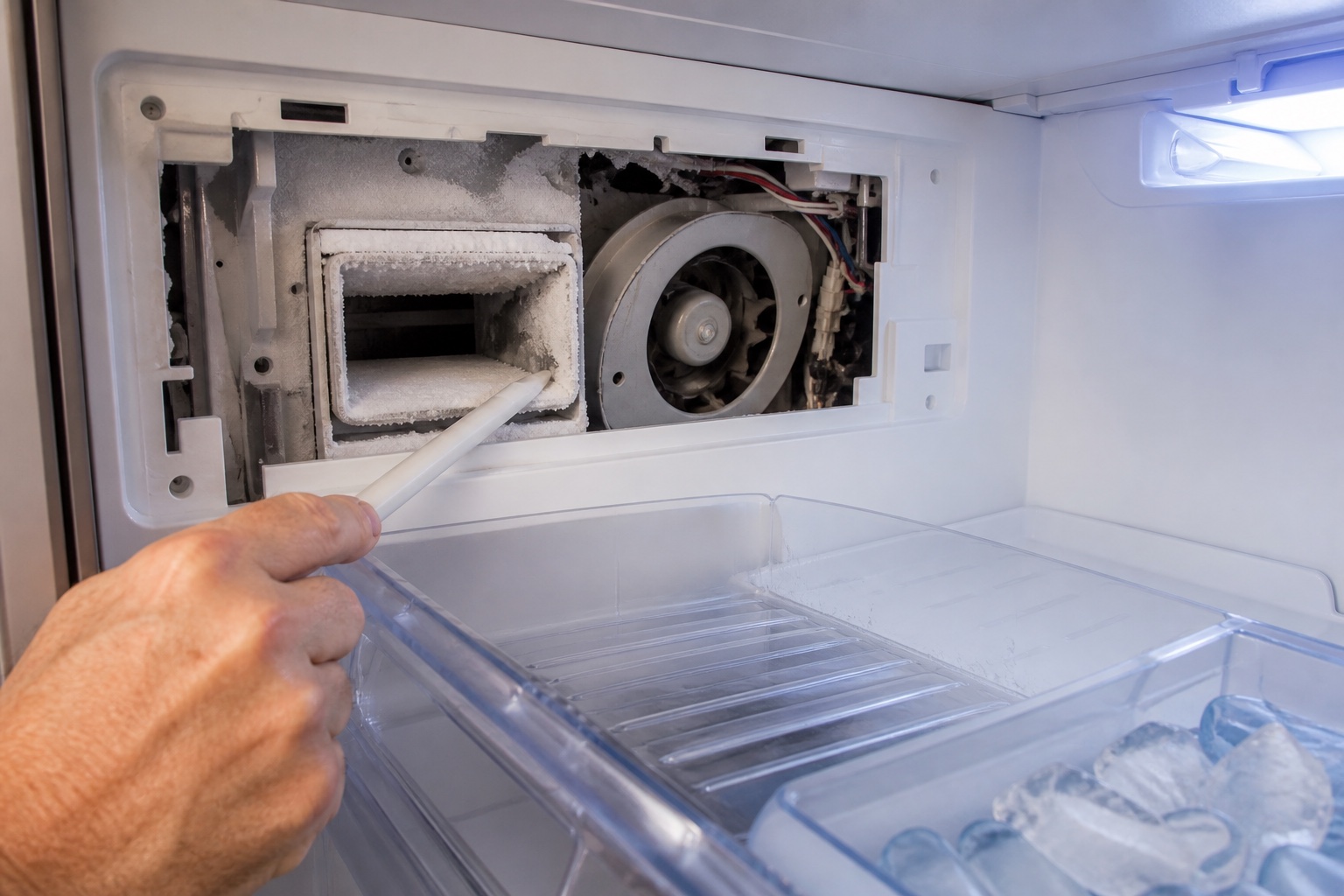
Local Ice Maker Service
We provide ice maker diagnostics and repair across Cape Coral, Fort Myers, and surrounding Southwest Florida service areas.
For scheduling, use the Contact page or call/text Art’s Appliance Repair directly.
Helpful Next Pages
These related guides and local service pages help connect the symptom to a practical repair path.
Related Appliance Guides
Ice Maker
Ice Maker Not Working After a Power Outage: What to Check
Ice maker stopped after a power outage? Check freezer temperature, water supply, reset behavior, airflow, error codes, and when to schedule repair.
Updated August 21, 2026
ice maker not working after a power outage
Ice Maker
Ice Maker Fills With Water but Does Not Make Ice: What to Check
Ice maker fills with water but never makes ice? Learn how freezer temperature, frozen cubes, harvest motors, heaters, sensors, and controls affect ice production.
Updated August 11, 2026
ice maker fills with water but does not make ice
Ice Maker
Ice Maker Not Making Ice: Temperature, Water, Filter, and Brand Clues
Ice maker not making ice? Separate production from dispensing, then record temperature, water, filter, and model clues before local service.
Updated October 2, 2026
ice maker not making iceNeed service?
Ice Maker Repair in Southwest Florida
Art’s Appliance Repair diagnoses refrigerator and ice-maker problems throughout Cape Coral, Fort Myers, North Fort Myers, Lehigh Acres, Estero, Bonita Springs, Naples, and surrounding Southwest Florida communities.
We diagnose problems including:
- ice maker works only in Test Mode;
- ice maker cycles but does not fill;
- ice maker fills but does not harvest;
- upper ice maker not producing ice;
- freezer ice maker not working;
- ice-room temperature and airflow problems;
- water inlet and filter problems;
- frozen fill tubes;
- ice-maker error codes;
- intermittent ice production.
Call or text (239) 688-9955 to schedule service.
Service call: $0 with an approved repair. $79 if no repair is completed.
View Ice Maker Repair