If There Is a Fire Inside the Microwave
NFPA: microwave oven safety and fire response
Ordinary repair booking is for after the immediate hazard has been handled. Do not wait for a service appointment to respond to an active fire.
Sparking Is Different From Food Popping
Arcing means electrical sparks. GE distinguishes ordinary food popping from abnormal electrical or mechanical sounds. A noise alone does not tell you which is happening. If you saw flashes, smelled electrical burning, or cannot confidently distinguish the sound, stop instead of repeating the event for a better look.
Metal utensils, metallic trim, foil touching the cavity, or an incorrectly positioned cooking rack can cause arcing. Use the exact model’s instructions for dishes and supplied accessories. A factory rack approved for one model or cooking mode is not permission to add an ordinary metal rack.
GE Appliances: arcing, food sounds and model-specific accessories
What You Can Check Once It Is Off and Cool
These are observations, not a clearance to restart. Only open the door once there is no ongoing fire or smoke and the appliance has cooled. Leave an unsafe, inaccessible or damaged power connection alone.
- Identify the container and any foil, twist tie, utensil or metallic decoration that was inside.
- Look at the visible walls, ceiling, turntable area and door frame without removing fixed panels or covers.
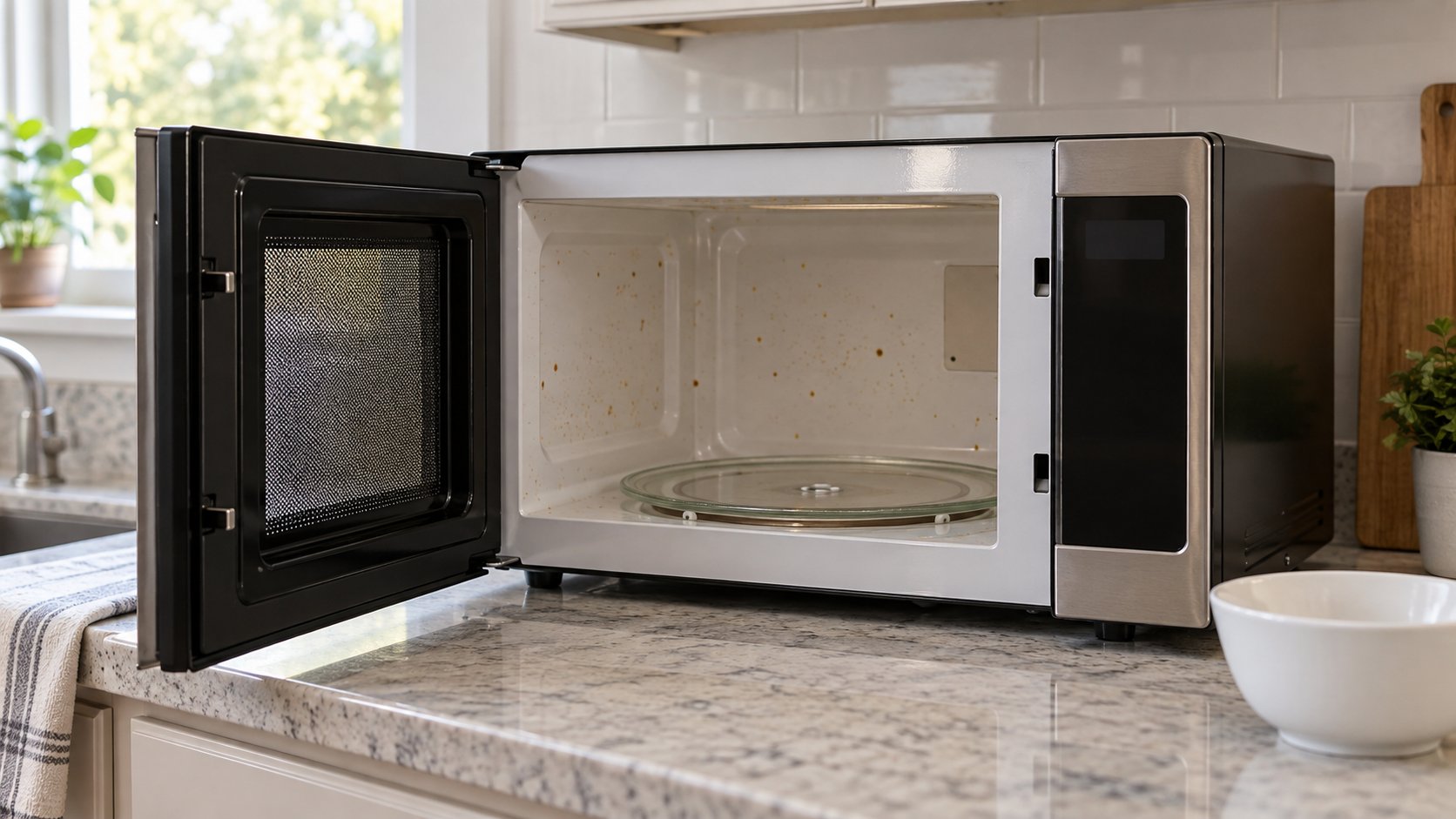
- Note whether a mark is loose food residue, a damaged cover, peeling coating or an apparent hole. If you cannot tell, photograph it while the appliance is off.
- Check the owner’s manual for the intended dish, rack and cooking mode. Do not test a suspect container in the sparking appliance.
- Keep it off if the cause is unclear, damage is visible, or sparking has already recurred. Do not create another episode to confirm a pattern.
Why It Can Spark Without an Obvious Metal Object
Whirlpool notes that soil buildup can contribute to arcing. For ordinary residue on an undamaged surface, follow the model’s cleaning instructions with the controls off and the oven cool. Its countertop guidance recommends mild, nonabrasive cleaning and a soft cloth, rather than steel wool or abrasive pads.
Skip heated-water or steam-clean cycles while a sparking fault is unresolved. Cleaning away food does not repair a burned cover or damaged cavity, and a cleaner-looking surface does not establish that the microwave is safe to run.
Whirlpool: cool-appliance cleaning and residue around the cavity
Leave the Small Interior Cover in Place
Some microwaves have a small cover on an interior wall or ceiling. This is often the waveguide cover, not packing material. Panasonic explains that it protects internal components from food, steam and moisture, and warns against operation without it. Its location and appearance vary by model.
If that area is scorched, cracked, missing or associated with sparks, leave the appliance off and request model-specific advice. Do not peel the cover off, cut a substitute, or run the microwave with it removed. A visible mark does not prove that replacing the cover alone will resolve the problem.
Panasonic: why the waveguide cover must stay in place
Cavity Damage Can Change the Repair Decision
Do not sand, tape, paint or patch a damaged interior to stop sparks. GE’s dedicated cavity-damage guidance calls for discontinuing use and replacement when the cavity wall has a hole or its coating is actively peeling or flaking. It distinguishes those conditions from minor surface chips, but does not offer an approved coating-repair method.
That is GE guidance, not a universal repair policy for every brand. Keep any visibly damaged microwave out of use until its manufacturer or a qualified service provider assesses the exact model and damage. Do not judge a hole’s safety from its apparent size.
GE Appliances: cavity holes, peeling coating and repair limits
Does Sparking Always Mean You Need a New Microwave?
No single answer fits every incident. The decision depends on whether the issue was an unsuitable item, an accessory, or damage to the appliance, and on the manufacturer’s repair limits. Ask what was found and what the complete repair would cost before deciding. Do not order a magnetron or control board based only on a flash.
Keep this guide to visible checks. Do not remove the outer cabinet, reach behind an interior cover, bypass a door interlock, or test internal electrical components. Unplugging the unit is not permission to open it for DIY diagnosis.
What to Send With a Local Service Request
A useful description is: ‘It flashed near the right interior wall while reheating in this dish; I stopped it and have left it off.’ That is an example of what to report, not a repair case or a diagnosis. Describe only what you actually observed.
- Brand and model from an accessible label, plus countertop, over-the-range or built-in installation.
- What food, container and accessories were inside and which cooking mode was selected.
- Where the flash appeared, any sound or smell, and whether smoke or fire occurred.
- A photo of the cool, switched-off interior and any visible mark; never restart it to take a video.
- Your service city and whether access requires removing a trim kit or lowering an installed microwave. Leave that removal for the service visit.
Art’s Appliance Repair serves Cape Coral, Fort Myers and its listed Southwest Florida service area. Send your location and model so coverage, repair suitability and availability can be confirmed. An online appointment time is a request and requires confirmation.
Microwave repair in Cape Coral
Microwave repair in Fort Myers
Request a microwave service appointment
Read the service call and warranty policy
Local Microwave Service
We provide microwave repair in Cape Coral and Fort Myers, along with surrounding Southwest Florida service areas.
For scheduling, use the Contact page or call/text Art’s Appliance Repair directly.
Related Appliance Guides
Microwave
Microwave Runs but Does Not Heat Food: Common Causes
Microwave running but not heating food? Learn the common causes, important safety warnings, and when to schedule microwave repair in Southwest Florida.
Updated August 3, 2026
Microwave runs but food stays cold
Appliance Tips
Appliances After a Power Surge: Warning Signs of Electrical Damage
Appliance acting differently after a power surge or outage? Learn the warning signs of electrical damage, what you can safely check, and when to schedule repair.
Updated August 18, 2026
Appliance warning signs after a power surgeNeed service?
Microwave Repair in Southwest Florida
Once the immediate hazard is over, Art’s Appliance Repair can help assess the microwave and explain the findings and price before work begins. Share the observations above so we can prepare for the visit.
The service call is $0 when an approved repair is completed; $79 if no repair is completed after diagnosis.
View Microwave Repair