First Question: When Does the Leak Start?
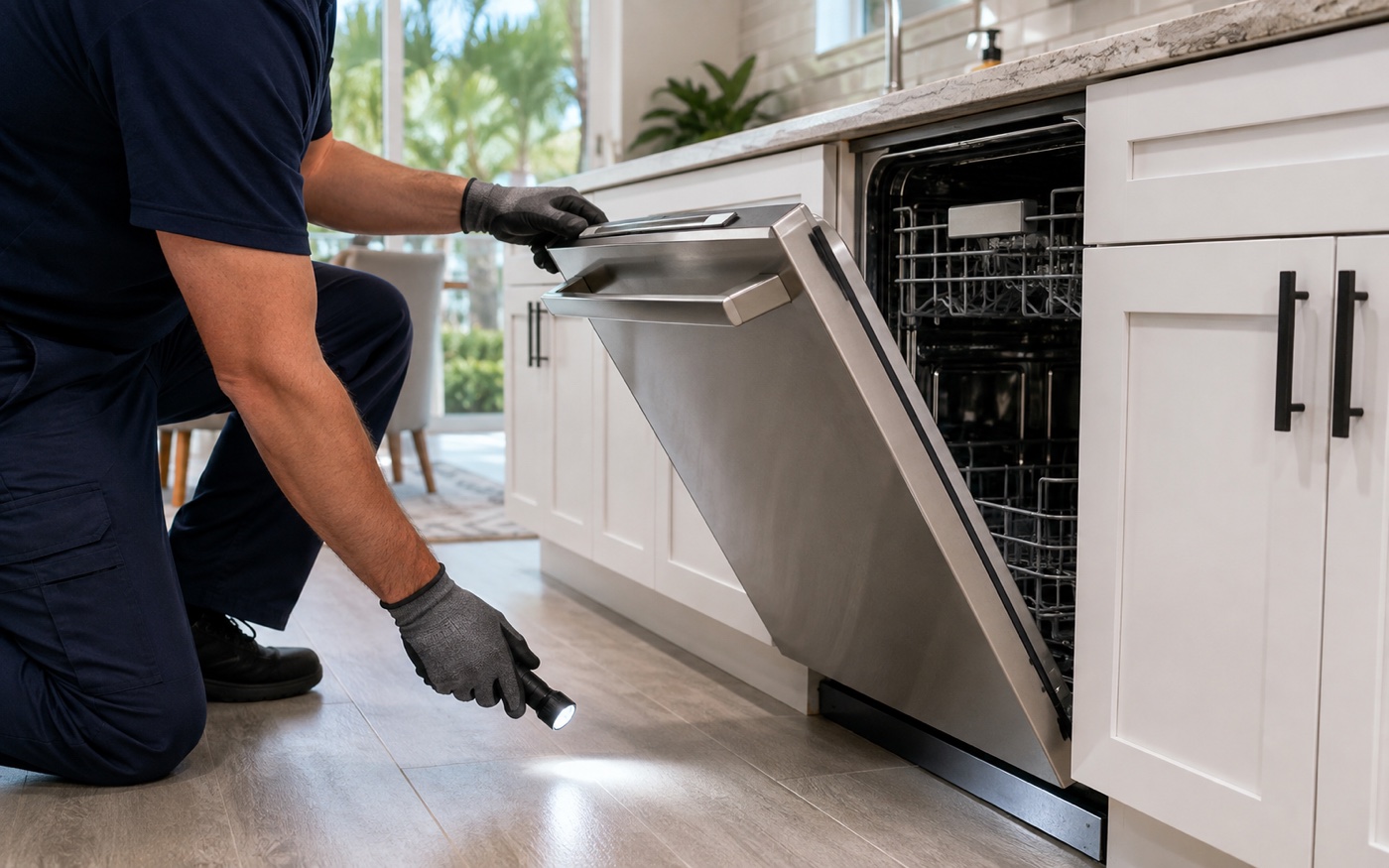
This is one of the best diagnostic clues. Stand near the dishwasher during a test cycle and observe the front without opening panels or contacting electrical components.
Water appears during the initial fill
Think about overfill, inlet valve behavior, float problems, tub level, or existing water already inside the machine.
Water appears only after the circulation pump starts
Think more about the spray arm, detergent suds, loading, door gasket, or door alignment.
Water appears during draining
The leak may not actually be from the door. Investigate the drain hose, pump area, sump, and connections underneath the dishwasher. Water can travel along the frame and emerge at the front, making the original source misleading.
Is It Really Coming Through the Door Seal?
Water on the floor in front of the dishwasher does not prove the gasket is leaking.
Before replacing anything, determine whether the first visible drop appears directly under the center of the door, at the left corner, at the right corner, behind the toe kick, or underneath the center of the machine.
A leak from a hose, pump, diverter, or inlet component may travel forward before reaching the floor.
Check for Too Many Suds Before Taking the Dishwasher Apart
Oversudsing can push water toward and through areas that normally do not leak.
This can happen when regular hand dish soap was used, dishes were heavily prewashed with dish soap, too much dishwasher detergent was added, or detergent residue remains from a previous mistake.
A useful clue
Open the dishwasher after stopping the cycle safely. If the tub contains a large amount of foam rather than normal wash water, fix the suds problem before assuming there is a mechanical leak.
A gasket will not stop water that is being pushed toward the door by excessive foam.
Loading Can Cause a Leak
A dishwasher may leak with one load and work perfectly with another. That can happen when a large item changes the spray pattern.
Examples include a cutting board, baking sheet, large frying pan, oversized plate, or utensil hanging below the rack.
Water from a spray arm can hit the item and be redirected directly toward the lower door seal.
Try this comparison
- Run the dishwasher with the problem load removed.
- Run the dishwasher with a normal balanced load.
If the leak disappears, loading or spray redirection may be the real cause.
Check Whether the Spray Arms Can Rotate Freely
Before running the dishwasher, rotate each accessible spray arm by hand.
Make sure it does not hit dishes, utensils, tall cookware, or rack components.
Now inspect the spray openings. A blocked spray hole can change the direction of the water jet and send water toward the front of the tub.
A Split Spray Arm Can Shoot Water at the Door
This failure is easy to miss. A plastic spray arm may crack along a seam.
When the circulation pump creates pressure, the crack can open and send a strong stream of water sideways instead of through the designed spray holes.
Possible symptoms include:
- leak begins only when washing starts;
- no leak during initial fill;
- water appears repeatedly at the same front corner;
- dishwasher otherwise fills and drains normally.
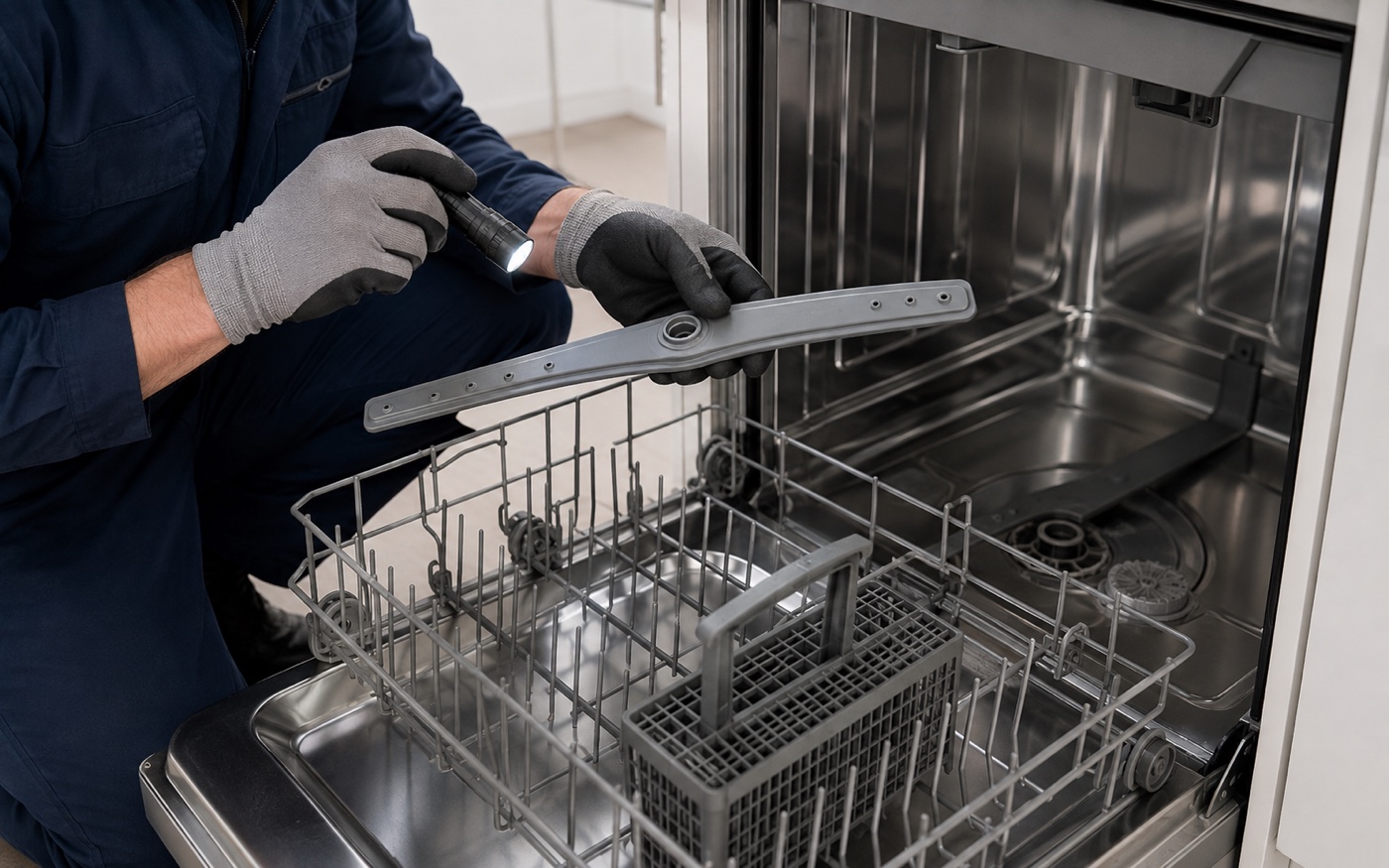
Inspect spray arms for visible cracks, separated seams, damaged end caps, and distortion. A damaged spray arm should generally be replaced rather than sealed.
Check the Door Gasket, but Inspect It Properly
The gasket around the dishwasher tub should create a consistent seal when the door closes.
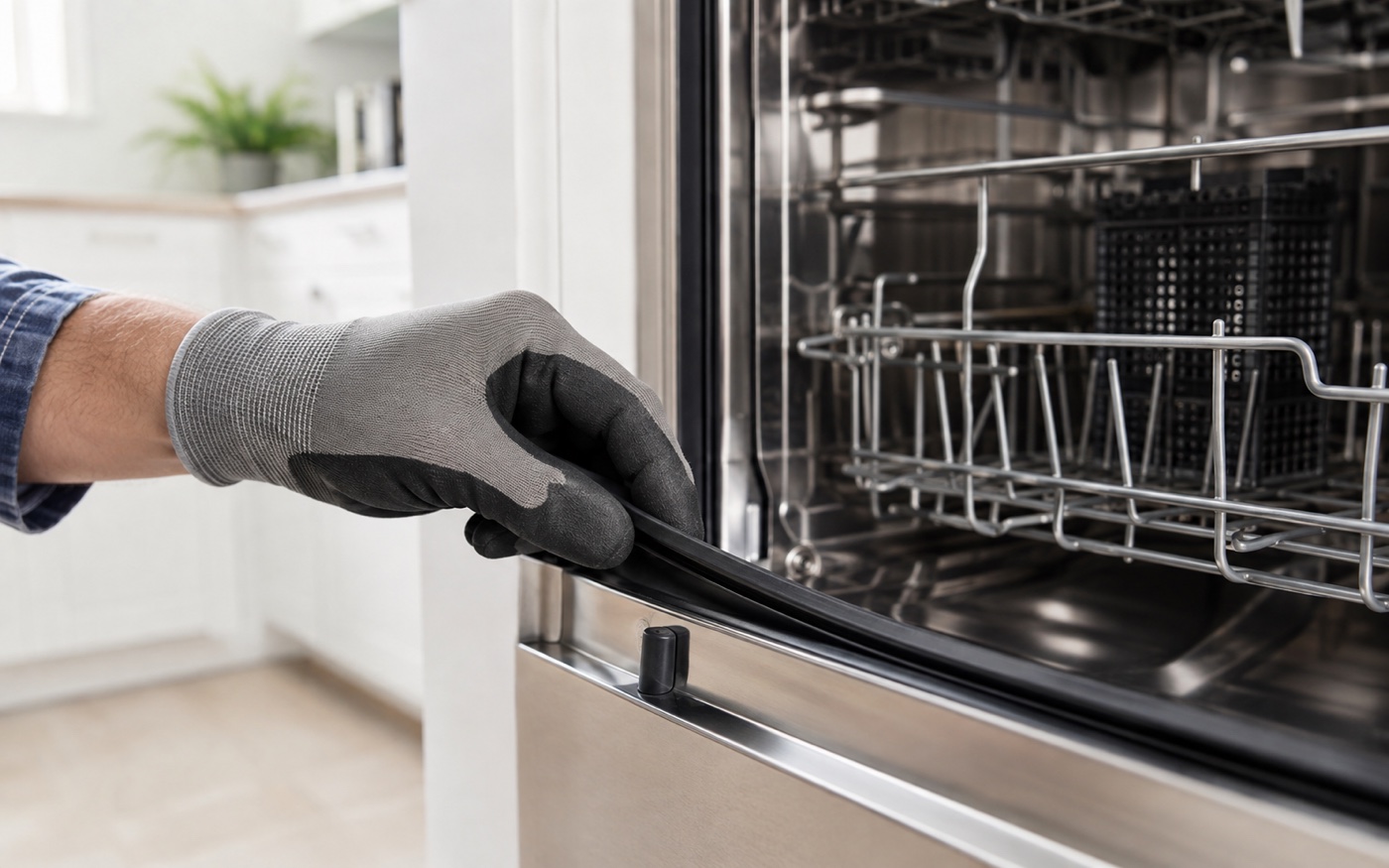
Look for torn sections, flattened areas, gasket pulled out of its channel, hardened rubber, food debris, grease, and mineral deposits.
Clean before replacing
Sometimes food or residue prevents the door from sealing correctly. Clean the gasket and mating surface gently with warm water, mild detergent, and a soft cloth. Avoid damaging or stretching the seal.
A New Dishwasher May Need Time for the Gasket to Seat
A minor door leak on a newly installed dishwasher does not always mean the gasket is defective.
A new gasket can sometimes need several complete wash cycles before it fully seats. That does not apply to a severe active leak, but a small initial seep from a stiff new gasket may improve after the gasket conforms to the door.
The Dishwasher Must Be Level and Square
A dishwasher can be inside the cabinet but still be installed incorrectly. The unit should be level and square because a distorted tub opening can prevent the door from sealing correctly.
Check side-to-side level, front-to-back level, all leveling legs, cabinet twist, and whether the door gap is consistent on both sides.
A useful visual clue
Close the door slowly and look at the reveal around the cabinet. If one side contacts before the other or the door appears twisted, installation should be checked before replacing the seal.
Why One Corner Can Leak More Than the Other
A corner leak often suggests geometry rather than a completely failed gasket.
Possible causes include the dishwasher being tilted, tub twisted in the cabinet, damaged corner of the gasket, door hinge alignment, or spray being redirected toward that side.
If water always appears at the same lower corner, inspect that area closely rather than replacing the entire wash system.
The Door May Not Be Closing Completely
A protruding dish, incorrectly positioned rack, or damaged latch can prevent full closure.
Check that racks are pushed in fully, no utensil sticks forward, no large food debris sits on the seal, the door latch engages normally, and the door is not contacting surrounding cabinetry.
Even the Toe Kick Can Matter
On some installations, an incorrectly positioned kick plate or trim piece can interfere with the door.
If the leak began immediately after installation, flooring work, cabinet adjustment, or kick-plate removal, check installation before replacing dishwasher components.
What if the Dishwasher Is Overfilling?
If the water level becomes higher than designed, water can eventually escape through the front.
Possible causes include a stuck float, float switch problem, inlet valve not closing, or control problem.
Clues that point toward overfill
- unusually high water level;
- leak begins during filling;
- dishwasher continues filling longer than expected;
- water approaches the bottom edge of the door;
- leak happens even before strong spraying begins.
Overfilling requires diagnosis before the machine is used again.
Check the Float
Many dishwashers have an overfill-protection float inside the tub. It should move freely on designs where user movement is expected.
Food residue or debris can interfere with it. Do not force or dismantle it without model-specific information.
If the dishwasher repeatedly overfills, the float, switch, inlet valve, and control circuit may need testing.
A Water Inlet Valve Can Leak Internally
The inlet valve is supposed to stop water flow when power to the valve is removed. A valve that does not close completely can allow excess water into the dishwasher.
Possible clues include water level rising when the dishwasher is not actively filling, unexpected water after sitting, repeated overfill, or a leak during or after fill.
This is different from a door gasket failure.
What if the Leak Happens Only During Heavy Wash?
Heavy cycles may create stronger or longer circulation conditions. If a small crack or sealing problem exists, it may appear only during Heavy, Pots and Pans, high-pressure zones, or certain rack-wash modes.
Compare the leak behavior between a Normal cycle and a Heavy cycle. Do not run repeated tests if water is reaching electrical components or flooring.
The Lower Door Area Is Not Always Designed Like a Refrigerator Gasket
Many dishwashers do not use a completely watertight gasket around every inch of the lower door edge.
The wash system is designed so water normally stays inside through spray direction, tub geometry, door seals, and controlled water level.
That is why excessive suds or incorrectly directed spray can create a front leak even if the visible gasket looks acceptable.
Check for Debris Around the Seal
Small pieces of food can prevent even a good gasket from contacting properly. Inspect for seeds, pasta, broken labels, food pieces, or grease buildup.
Clean the area before ordering a gasket.
Could the Door Hinge Be the Problem?
Door alignment can be affected by a bent hinge, damaged hinge bracket, installation pressure, loose mounting, or cabinet twist.
Possible clues include the door sitting lower on one side, uneven gasket contact, different latch alignment, or a leak that began after the door was forced downward.
If the door itself is mechanically out of alignment, a new gasket may still leak.
What if Water Comes From the Vent Area?
Some dishwasher designs include a vent in or near the door. A leak that appears near one side of the front panel may involve the vent assembly, vent gasket, excess suds, excessive water, or a model-specific drying system.
Why Replacing the Gasket First Can Be a Mistake
Suppose a dishwasher leaks from the front, a gasket is replaced, and the dishwasher still leaks.
The actual cause may have been oversudsing, a cracked spray arm, improper leveling, overfill, blocked door, or door misalignment.
A gasket should be replaced when inspection or testing actually shows that it is damaged, distorted, or unable to seal.
What We Often Find During Service Calls
A useful distinction is whether the dishwasher leaks before or after the circulation pump starts.
If the machine fills normally without leaking but water appears almost immediately when strong washing begins, we look closely at spray arms, loading, suds, and door sealing.
If water begins escaping while the tub is still filling, we move toward water level, float, inlet valve, and installation angle. That timing often tells us more than simply seeing water on the floor.
A Practical Diagnostic Sequence
- Dry the floor and front edge so you can identify the first new drop.
- Make sure only automatic dishwasher detergent is being used.
- Remove oversized items and anything extending outside the rack.
- Make sure the spray arms move freely.
- Look for clogged spray holes or cracks.
- Clean the gasket and inspect it for damage.
- Check level and door alignment.
- Observe whether the leak begins during fill, wash, or drain.
What You Can Safely Check Yourself
You can safely inspect detergent type, excess foam, rack loading, spray-arm movement, visible spray-arm damage, door gasket condition, debris around the seal, dishwasher level, whether the door closes evenly, and visible float movement where applicable.
When You Should Stop Using the Dishwasher
Do not continue operating it if water spreads underneath cabinetry, water reaches electrical wiring, the dishwasher repeatedly overfills, the breaker trips, the leak is increasing, flooring is being damaged, or water is entering the toe-kick electrical area.
Information That Helps Before a Service Visit
Send the dishwasher brand, full model number, photo or video of the leak, whether it is on the left, center, or right side, whether it leaks during fill, wash, or drain, whether it happens with every load, detergent type, whether the dishwasher was recently installed or moved, and any error code.
Check common appliance error codes
A short video showing the first moment the water appears can be particularly useful.
When Should You Call a Dishwasher Technician?
Professional diagnosis is appropriate when:
- gasket is damaged;
- dishwasher is correctly loaded but still leaks;
- spray arm is cracked;
- machine overfills;
- float operation is questionable;
- inlet valve does not stop filling;
- door is misaligned;
- leak appears underneath rather than through the seal;
- water reaches electrical components;
- the source cannot be identified safely.
A technician can distinguish a true door leak from a pump, sump, hose, valve, or installation leak that only appears at the front.
Is a Door Leak Usually Repairable?
Yes. Common repair areas include the door gasket, spray arm, float system, inlet valve, latch, hinge, and installation adjustment.
More substantial repairs may be needed if the leak involves a cracked tub, pump housing, sump, or major structural damage. The exact source should be identified before deciding whether repair is worthwhile.
Photo guide
Diagnostic Photos
Local Dishwasher Service
We provide dishwasher repair in Cape Coral and Fort Myers, along with surrounding Southwest Florida service areas.
For scheduling, use the Contact page or call/text Art’s Appliance Repair directly.
Related Appliance Guides
Dishwasher
Dishwasher Runs but Does Not Clean the Dishes: Common Causes
Dishwasher leaves dirty dishes or an undissolved pod? Check dispenser access, detergent and wash symptoms, then find local repair in Cape Coral or Fort Myers.
Updated September 14, 2026
dishwasher runs but does not clean dishes
Dishwasher
Dishwasher Has Standing Water: Appliance Drain or Household Plumbing?
Standing water after a dishwasher cycle can come from the filter area, drain hose, disposal connection, or household plumbing. Use safe checks before local repair.
Updated September 28, 2026
dishwasher standing water
Dishwasher
Dishwasher Is Not Drying the Dishes: What Usually Causes It?
Dishwasher leaving dishes wet? Learn how rinse aid, loading, dry settings, water temperature, heating, vents, and drain problems affect drying.
Updated August 20, 2026
dishwasher not drying dishesNeed service?
Dishwasher Repair in Cape Coral, Fort Myers and Southwest Florida
Art’s Appliance Repair diagnoses dishwasher leaks throughout Cape Coral, Fort Myers, North Fort Myers, Lehigh Acres, Estero, Bonita Springs, Naples, and surrounding Southwest Florida communities.
We diagnose dishwasher leaking from under the door, leaking from one front corner, damaged door gaskets, cracked spray arms, overfilling, float and inlet-valve problems, excessive suds, dishwasher leaks underneath, door alignment problems, and pump or sump leaks.
Call or text (239) 688-9955 to schedule dishwasher service.
The service call is $0 when the diagnosed repair is approved and completed. If no repair is completed, the diagnostic service call is $79.
View Dishwasher Repair