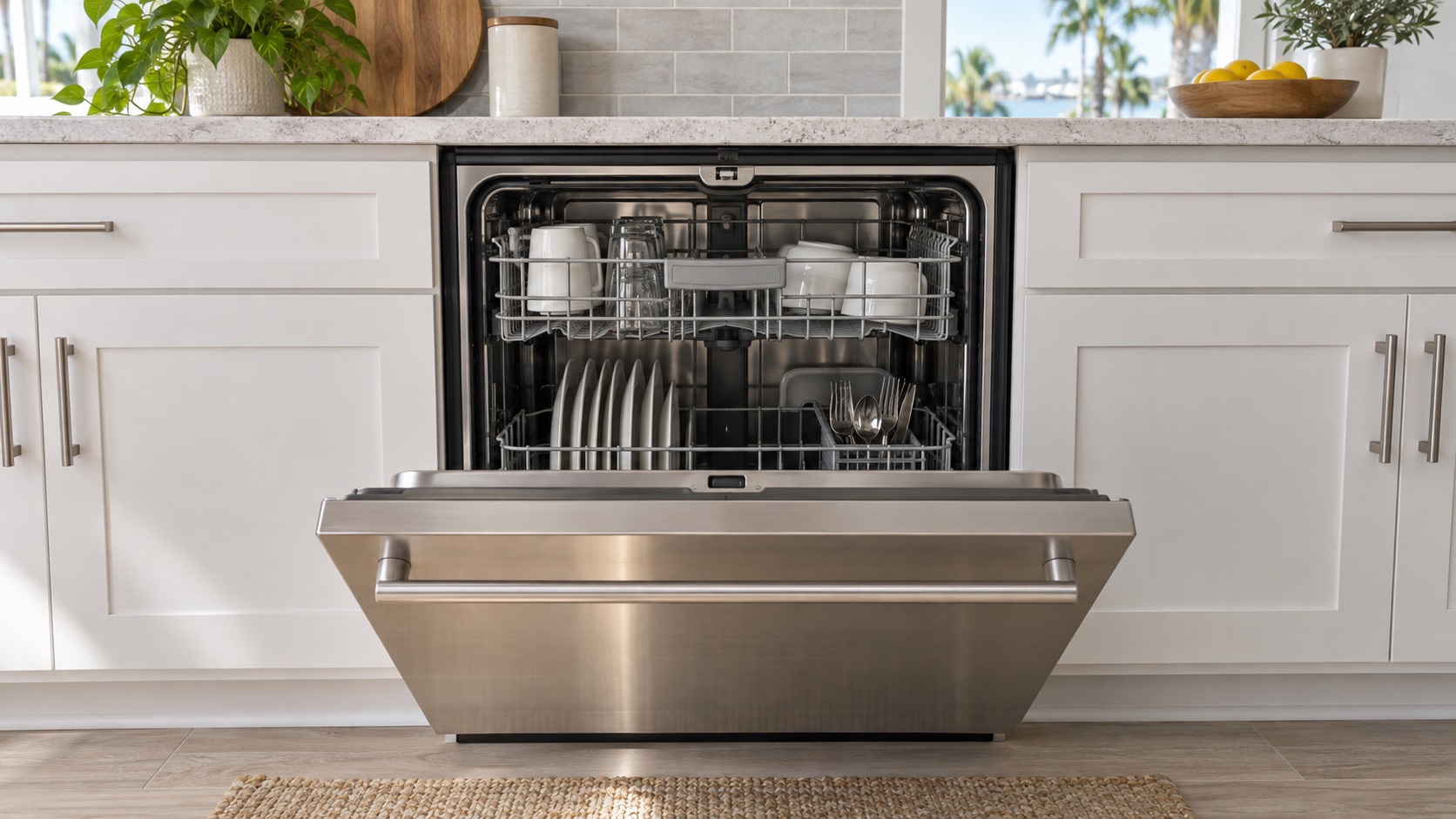
Stop Before Forcing a Dishwasher Door
Do not operate the dishwasher by holding the door inward, taping it shut, or bypassing the latch switch. The closed-door confirmation is a safety function, and cabinet or latch interference can also affect sealing. Stop use if the door cannot stay closed, the tub looks twisted in the opening, the door suddenly drops, or water reaches the floor or an electrical area.
A recently installed or moved dishwasher deserves an installation check before a latch is ordered. GE and Samsung both identify cabinet contact, mounting hardware, alignment, and level as possible closure concerns. Those observations do not prove the latch itself is defective.
GE Appliances: dishwasher door will not close or latch
GE Appliances: dishwasher door hitting cabinets or countertop
Safe Checks for a Dishwasher Door That Will Not Latch
- Turn the dishwasher off. Remove large pans, cutting boards, tall plates, and utensil handles that project beyond a rack.
- Push the upper and lower racks fully into their normal positions. Check for a utensil or small item that has fallen through and blocks a rack or the door path.
- If the upper rack adjusts, confirm that both sides sit at the same height. Follow only the exact model manual; do not force a track or adjuster.
- Look for contact between the door and a cabinet face, mounting screw, bracket, countertop edge, flooring, trim, or insulation. Photograph the contact point without loosening hardware.
- Compare the spacing along the left and right edges. An uneven gap or rubbing at one corner is an alignment clue, not permission to bend the door, strike, or hinge.
- With the door supported and the power off, inspect the visible latch and strike for food debris, a foreign object, obvious breakage, or a part stuck in an unusual position. Do not insert tools, lubricate the latch, or reach behind panels.
- Inspect the accessible door seal for debris, a fold, or a displaced section. Clean only by the exact model guidance; do not remove or stretch the seal.
- Try closing the empty dishwasher gently without starting a cycle. Record whether the door stops early, reaches the frame but will not catch, catches and releases, or sits visibly uneven.
Samsung and GE both tell owners to check loading and fully seated racks before assuming a part has failed. Whirlpool also identifies seal obstruction, rack interference, installation position, and a broken latch as different possible causes. The correct next step depends on which behavior you observe.
Samsung: dishwasher door will not close
Whirlpool: dishwasher door will not close
Door Stops Before It Reaches the Latch
When the door stops short, focus first on the physical path rather than the control board. A rack that is not fully seated, an oversized dish, a utensil below the lower rack, an uneven upper rack, seal debris, or contact with the cabinet can prevent the door from reaching the strike.
Close the empty dishwasher only far enough to observe where resistance begins. Do not use the door as a lever. If an empty door still contacts the opening after new installation, cabinet work, countertop replacement, floor work, or moving the appliance, contact the installer or a qualified technician.
Door Reaches the Frame but Will Not Catch
A door that reaches the frame but springs open can involve the visible latch or strike, door alignment, frame distortion, seal fit, hinge position, or a model-specific door-opening feature. A similar symptom can come from different components, so appearance alone is not enough to order a latch.
On covered Samsung AutoRelease models, temporary extended rods can hold the door open after a cycle. Samsung warns against forcing the door because the feature and timing are model-specific. Check the exact manual before treating an intentional position as a failed latch.
Door Closes, but the Dishwasher Still Will Not Start
If the door closes with normal resistance and remains shut, the physical closure problem may be resolved. A cycle that still will not begin can involve Control Lock, Delay Start, a door switch that does not confirm closure, water supply, leak protection, controls, wiring, or a model-specific error.
Do not keep slamming or pressing on the door to make the cycle start. Record any light pattern or code and use the dishwasher has power but won’t start guide for the separate startup path.
Samsung notes that a reset will not correct a door that is not completely closing. Record the physical symptom and any code before removing power; one model-appropriate reset is not a repair for recurring closure or latch behavior.
Samsung: when to reset a dishwasher
Installation and Cabinet Clues
- The symptom began immediately after installation or the dishwasher was moved.
- The door rubs one cabinet side, a mounting screw, or the countertop edge.
- The gap is narrower on one side or changes as the door moves.
- A rack rolls forward or backward on its own when the appliance is empty.
- The door closes when the mounting area is untouched but binds after cabinet or countertop work.
- The tub or frame appears pulled, twisted, or no longer square in the opening.
Samsung’s leveling guidance links door clearance and closure with installation position, but detailed leveling may require toe-kick access, tools, and model-specific steps. Limit homeowner action to observation unless the exact manual identifies an owner procedure and the appliance is safely supported.
Samsung: level a dishwasher for door clearance
What Professional Diagnosis May Need to Separate
- Rack, adjuster, track, dish, or utensil interference.
- Visible latch or strike damage versus alignment that prevents normal engagement.
- A mechanical latch concern versus a door switch or control-confirmation problem.
- Cabinet, countertop, mounting, level, tub-frame, or installation interference.
- Door seal fit versus a hinge, spring, cable, balance, or support concern.
- A model-specific automatic door-opening feature versus unintended release.
- Door closure trouble versus a separate leak or no-start condition.
Bosch likewise separates loading and level checks from latch, hinge, and door-lock concerns that may require professional repair. Brand guidance helps define safe observations, but the complete model number is needed before parts or procedures are chosen.
Bosch: dishwasher troubleshooting
What to Include in a Cape Coral or Fort Myers Repair Request
Share your city or ZIP code privately so Art’s Appliance Repair can confirm route coverage, dishwasher eligibility, and appointment availability. A preferred online time is a request and requires confirmation.
- Brand and complete model number.
- Whether the door closes and latches when both racks are empty.
- Whether the door stops early, reaches the frame but springs open, or latches and then releases.
- A safe photo of the visible latch and strike area, plus any cabinet contact point.
- Any scraping, dropping, uneven weight, leak, light pattern, or error code.
- Recent dishwasher installation, removal, cabinet, countertop, flooring, rack, or hinge work.
The service call is waived when the diagnosed repair is approved and completed. Diagnosis is $79 for one appliance or $100 total for two appliances. The recommended repair and price are provided for approval before billable repair work begins.
Service-call and warranty policy
Dishwasher Door and Latch Diagnosis in Southwest Florida
Art’s Appliance Repair diagnoses dishwasher door, latch, strike, rack, hinge, alignment, installation, and no-start concerns in Cape Coral, Fort Myers, and the confirmed Southwest Florida service area. Share the model and closure behavior above so we can verify the correct service path before scheduling.
Local Dishwasher Service
Relevant local service pages include dishwasher repair in Cape Coral, Fort Myers dishwasher repair, dishwasher repair in North Fort Myers, and Lehigh Acres dishwasher repair. We also serve surrounding Southwest Florida service areas.
For scheduling, use the Contact page or call/text Art’s Appliance Repair directly.
Related Appliance Guides
Dishwasher
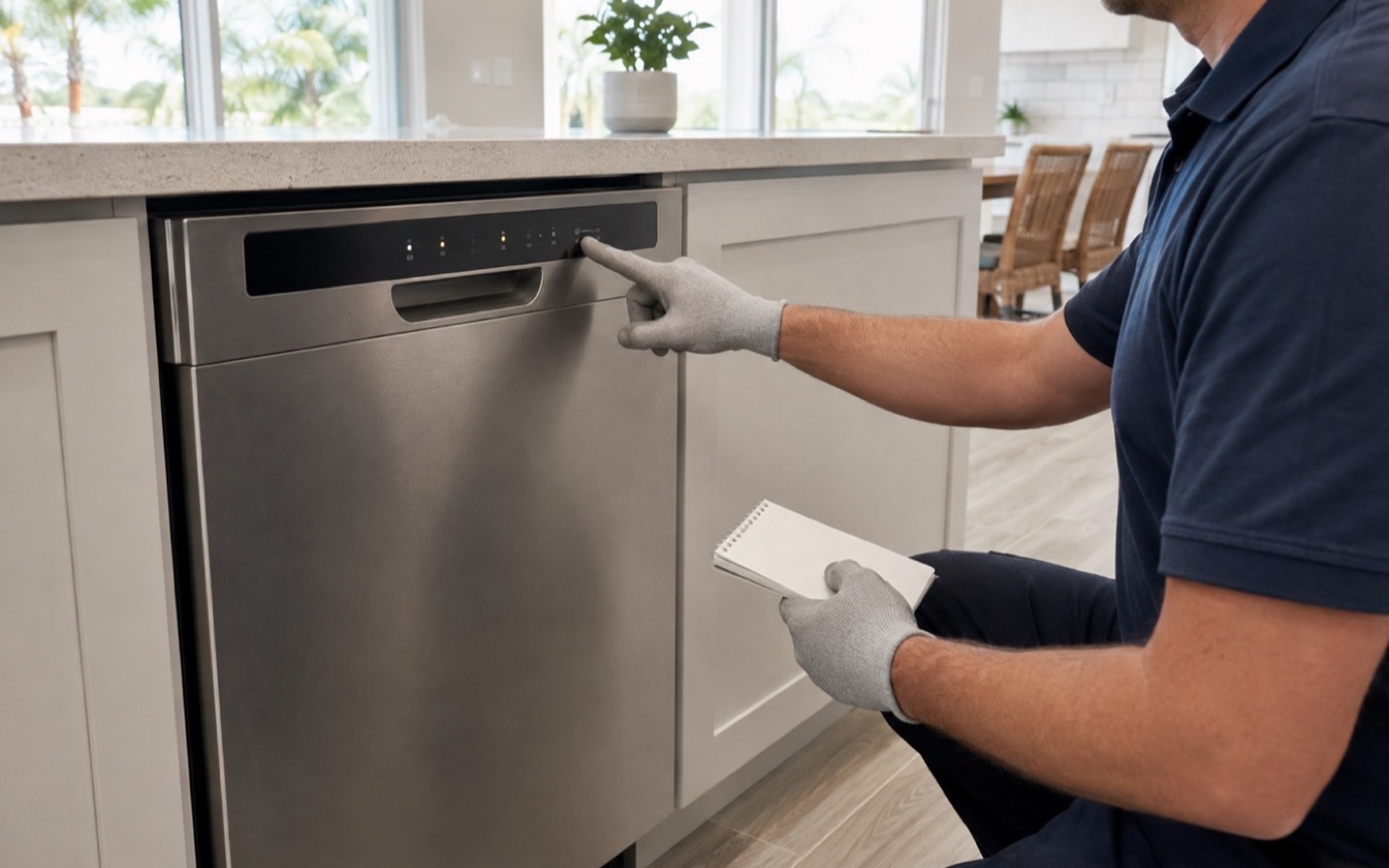
Dishwasher Has Power but Won’t Start: What to Check
Dishwasher has lights but won’t start? Check Control Lock, Delay Start, the door latch, water supply, leak protection and controls before replacing parts.
Updated September 9, 2026
dishwasher closes but will not start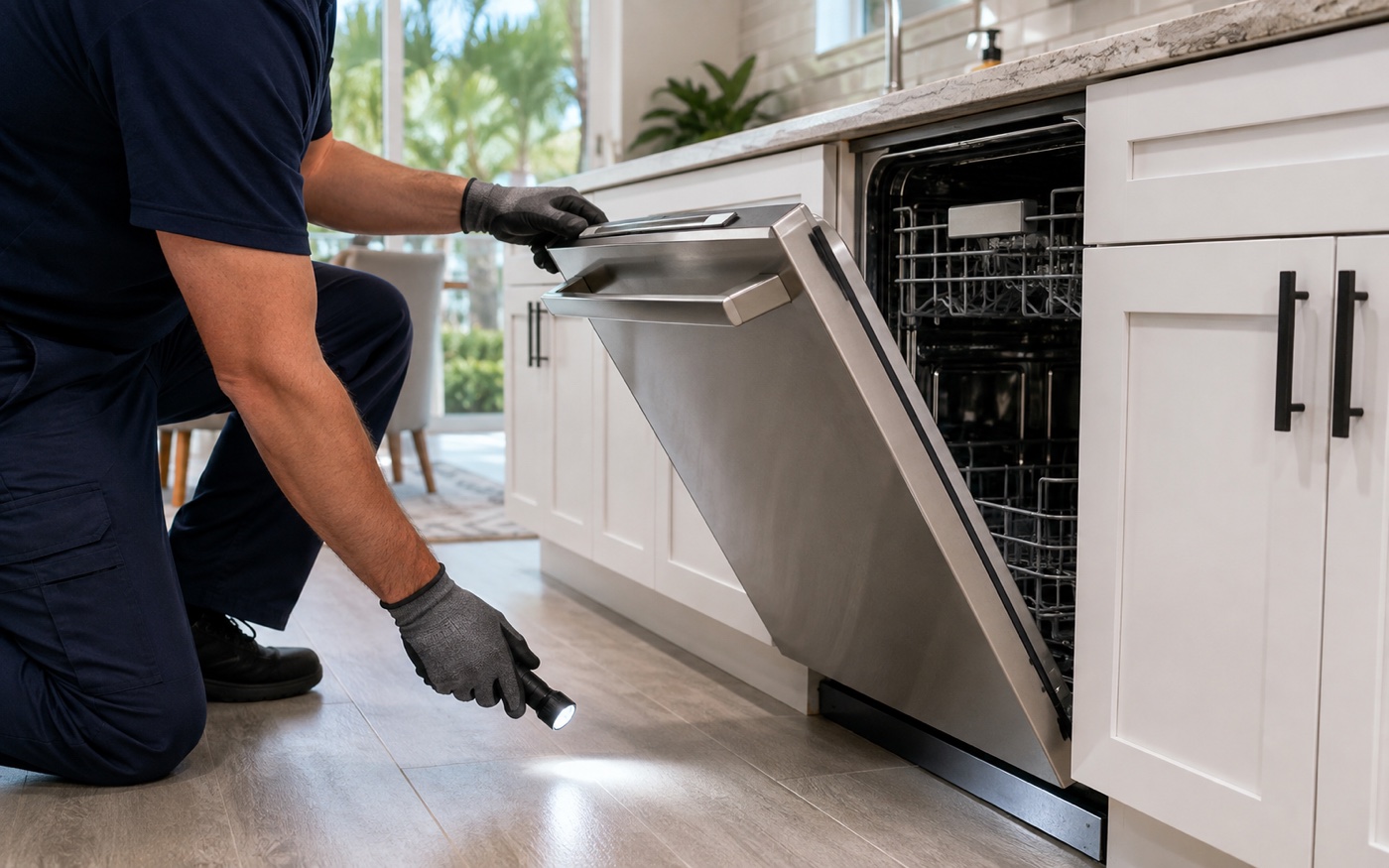
Dishwasher
Dishwasher Is Leaking From Under the Door: What Usually Causes It?
Dishwasher leaking from the bottom of the door? Learn how gasket problems, suds, spray arms, leveling, loading, and overfilling can cause front leaks.
Updated September 3, 2026
dishwasher leaks from under the door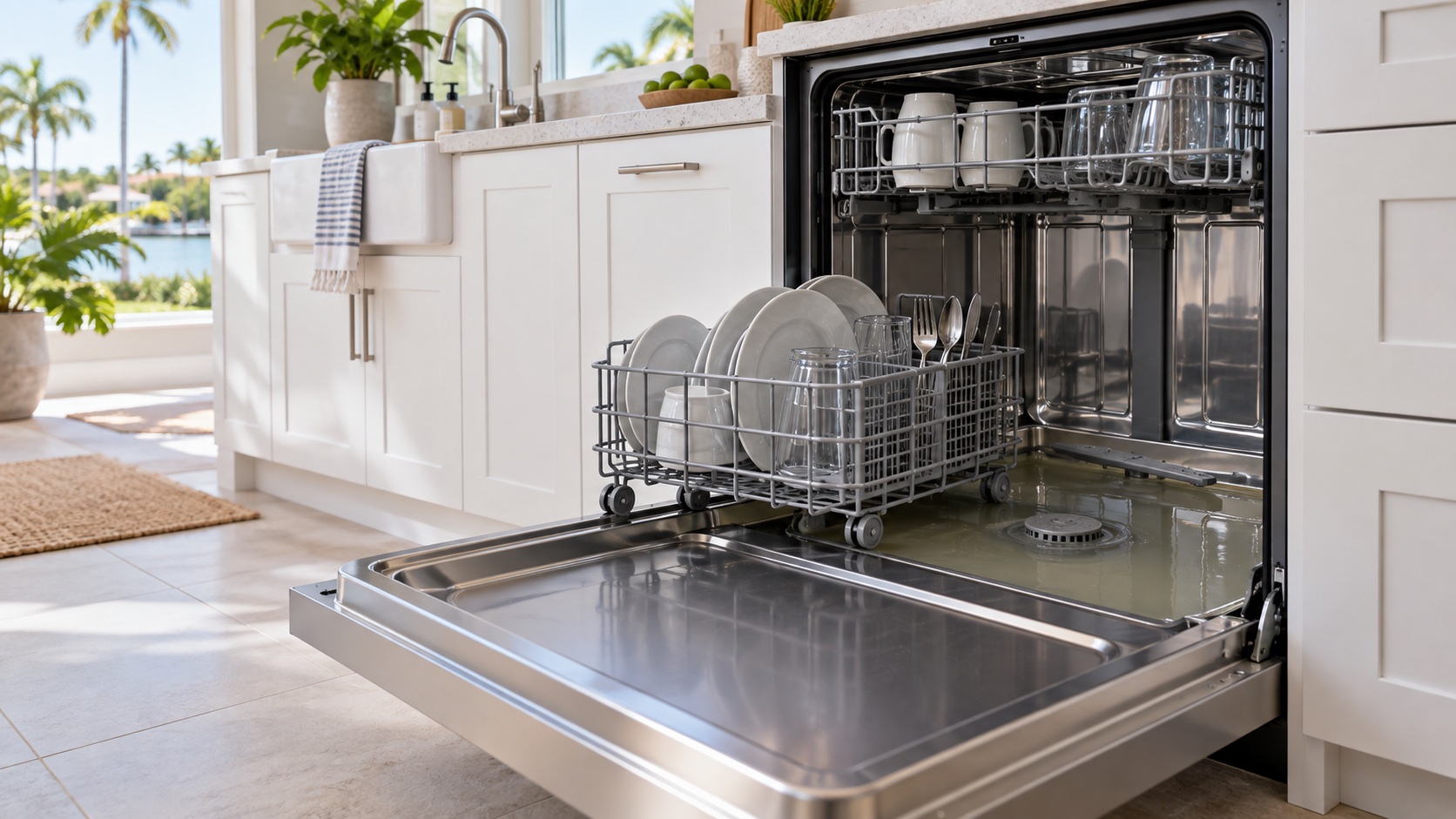
Dishwasher
Dishwasher Has Standing Water: Appliance Drain or Household Plumbing?
Standing water after a dishwasher cycle can come from the filter area, drain hose, disposal connection, or household plumbing. Use safe checks before local repair.
Updated September 28, 2026
dishwasher has standing water